Both testes normally settle into the scrotum before or shortly after birth. When one — or occasionally both — has not, it is called an undescended testis, and it is one of the more common conditions a pediatric urologist sees in infant boys.
What Undescended Testis Means
During development, the testes form near the kidneys and gradually move down into the scrotum, usually completing the journey before birth. In some boys — more often in those born premature — one testis stops short of the scrotum, remaining in the groin or abdomen.
Why It Sometimes Resolves on Its Own
In many babies, the testis continues to descend naturally in the first few months of life. This is why pediatricians usually recommend simply monitoring at first, particularly in premature infants, rather than intervening immediately.
Why Timing of Surgery Matters
If the testis has not descended by around 12–18 months of age, surgery (orchidopexy) to bring it down and fix it in the scrotum is recommended — and the timing genuinely matters for two reasons:
- Fertility protection — a testis that remains outside the scrotum for longer is exposed to higher body temperature, which can affect sperm-producing tissue over time
- Future self-examination — a testis fixed in the scrotum can be checked by the person themselves in adulthood, which matters because undescended testis carries a modestly higher lifetime risk that is easier to monitor when the testis is accessible
Waiting well beyond the recommended age does not give the testis "more time" to descend on its own — after infancy, spontaneous descent is very unlikely, and delay simply narrows the window for the best long-term outcome.
What Orchidopexy Involves
Orchidopexy is typically a day-care procedure, often performed laparoscopically when the testis is higher up in the abdomen. The surgeon brings the testis down and secures it in the scrotum, where it can grow and function normally.
Retractile Testis: A Common Look-Alike
Not every "missing" testis is truly undescended. A retractile testis pulls up into the groin due to a reflex (especially in cold weather or when examined) but can be guided back down into the scrotum on examination — this usually needs no surgery, only periodic review. A pediatric urologist can tell the two apart reliably.
Long-Term Outlook
With timely correction, most boys go on to have normal testicular function and fertility potential. Regular follow-up, including learning testicular self-examination in the teenage years, is a simple, sensible long-term habit.
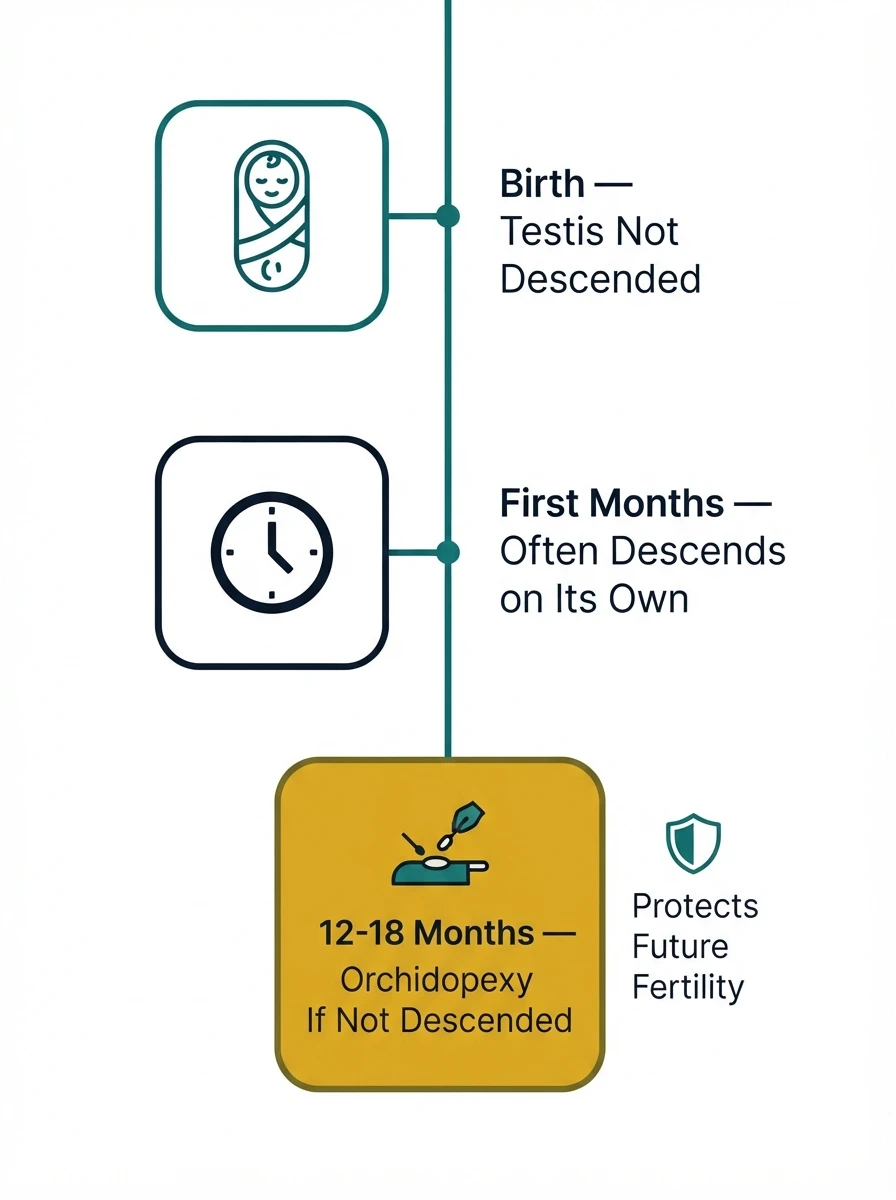
When undescended testis resolves on its own, and when surgery is recommended.
Empty or Undeveloped Scrotum on One Side?
Dr. Venkatesh Kolla can assess whether the testis is undescended, retractile, or absent, and advise on the right timing for treatment.
📅 Book a Consultation 💬 WhatsApp Us