Call +91-8282 8989 18 immediately. Note the time symptoms started. Keep the person calm and still. Do not give food, water, or any medication. Sri Ganga Hospital is open 24×7 — calling ahead means the team is ready the moment you arrive. Every minute matters.
A stroke can happen to anyone — young or old, with or without warning. It does not always look dramatic. Sometimes it is a lopsided smile, a suddenly heavy arm, or words that come out wrong. The people who recognise it fast and act in the first minutes give the patient the best possible chance. The people who wait — hoping it will pass — often do not.
What this article covers
- What is a stroke — in plain language
- The FAST signs — what every family must know
- Beyond FAST — signs people miss
- Why every minute matters — time is brain
- What to do in the first minutes
- What never to do
- TIA — the warning stroke most people ignore
- Who is at high risk
- What happens when you arrive at Sri Ganga
- Frequently asked questions
What Is a Stroke — In Plain Language
The brain controls every function in the body — movement, speech, vision, memory, breathing. To do this, it needs a constant, uninterrupted supply of blood carrying oxygen and nutrients. A stroke happens when that supply is suddenly cut off.
There are two main types:
- Ischaemic stroke (about 85% of cases) — a blood clot blocks an artery supplying the brain. The same mechanism as a heart attack, but in the brain.
- Haemorrhagic stroke — a blood vessel in the brain bursts, flooding surrounding tissue with blood and causing pressure damage.
One critical difference from a heart attack: stroke patients often feel no pain. There is no chest pressure, no obvious physical distress. The damage is happening silently inside the brain — which is exactly why recognising the external signs (FAST) is so important. The patient may not know something is seriously wrong. The family or bystander is often the one who must act.
🧠 Stroke is sometimes called a "brain attack" — the term is deliberate. It carries the same urgency as a heart attack. The same time-critical thinking applies. The same call-immediately principle applies. The same "do not wait and see" rule applies.
The FAST Signs — What Every Family Must Know
FAST is a simple, proven tool used by emergency services worldwide to identify stroke in seconds. You do not need medical training to use it. Every adult and older child should know it.
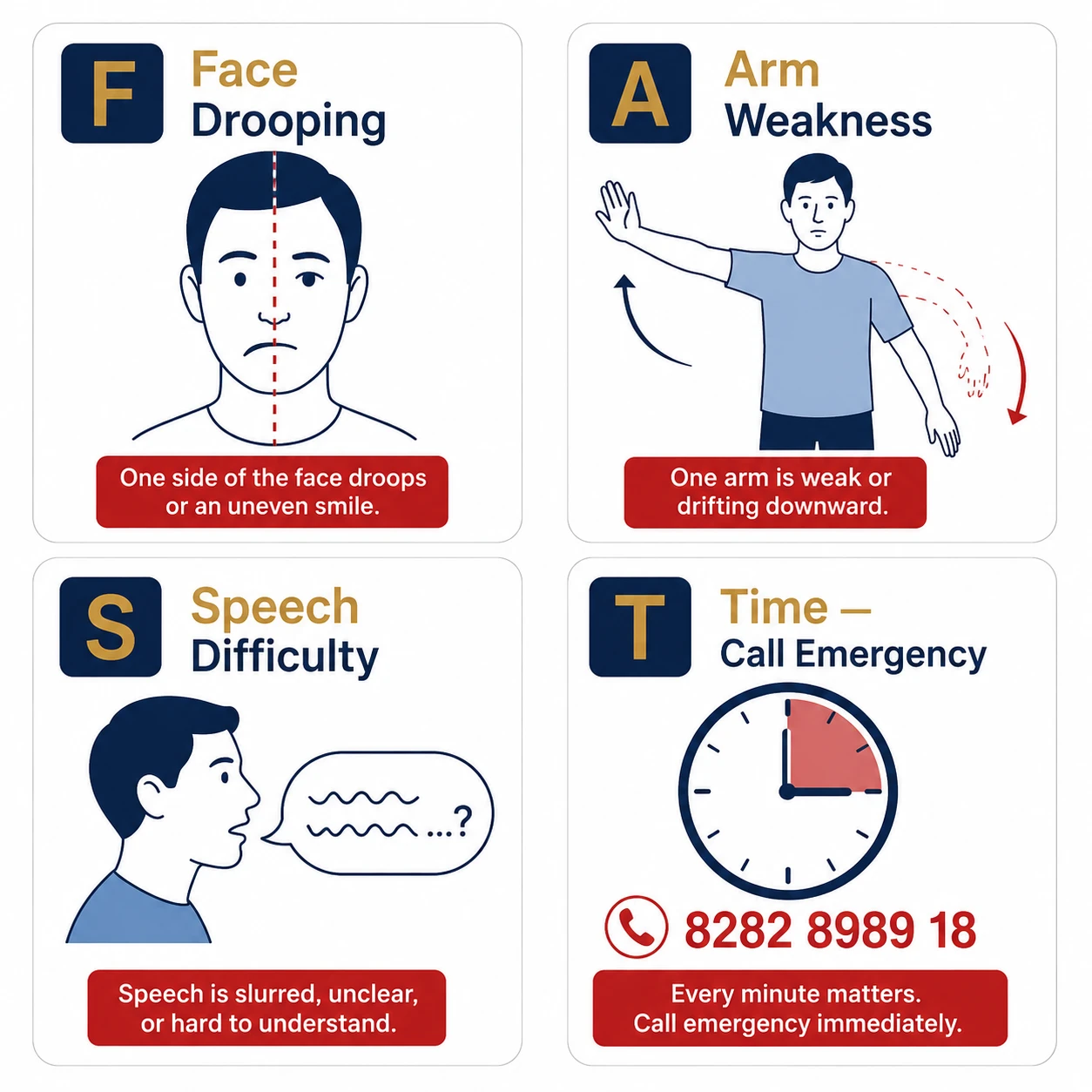
Figure 1: The FAST signs of stroke. If you see any one of these signs, call +91-8282 8989 18 immediately — do not wait for all four to appear.
🚨 F·A·S·T — check all three, then act
Ask the person to smile. Is one side of their face drooping or numb? Does their smile look uneven — one corner pulled down? Ask them to stick out their tongue — does it deviate to one side? Any facial asymmetry that appeared suddenly is a red flag.
Ask the person to raise both arms and hold them out in front. Does one arm drift downward, feel weak, or go numb? Can they grip your hand equally on both sides? One-sided arm weakness or numbness that came on suddenly is a stroke sign.
Ask the person to repeat a simple sentence — "The sky is blue" or their own name. Is their speech slurred, strange, or impossible to understand? Can they understand what you are saying? Sudden difficulty speaking or understanding language is one of the most telling stroke signs.
If you see any one of the above signs — not all three, just one — call +91-8282 8989 18 immediately. Note the exact time the symptom appeared. This information directly affects treatment decisions at the hospital. Do not drive to a pharmacy. Do not wait to see if it gets better. Call now.
One important point: you do not need to see all three signs. A single FAST sign that appeared suddenly is enough to call. The test is not about certainty — it is about speed. If you are unsure, the right answer is always to call and let the emergency team assess.
Beyond FAST — Signs People Miss
FAST covers the most common and recognisable stroke presentations, but not all strokes show up in the face, arm, and speech. Some strokes — particularly those affecting the back (posterior) part of the brain — present with different symptoms that are frequently missed or dismissed.
⚠️ These are also stroke warning signs — call immediately if any appear suddenly
- Sudden, severe headache with no obvious cause — often described as "the worst headache of my life" or a "thunderclap." This can signal a haemorrhagic stroke and is a medical emergency.
- Sudden vision loss or double vision — in one or both eyes, or a sudden loss of vision in half the visual field (everything to the left or right goes dark).
- Sudden loss of balance or coordination — unexplained dizziness, unsteadiness, or inability to walk straight that came on without warning.
- Sudden severe confusion — beyond normal tiredness, a sudden inability to understand surroundings, follow conversation, or know where they are.
- Sudden numbness on one side of the body — face, arm, or leg, especially if one-sided and sudden in onset.
The key word across all stroke signs — FAST or beyond — is sudden. Stroke symptoms come on abruptly, not gradually. A headache that has been building all day is far less likely to be a stroke than a headache that hit with full force in a single moment. Sudden onset is the signal.
Why Every Minute Matters — Time Is Brain
The phrase used by neurologists is "time is brain" — and the numbers behind it are stark. During a stroke, approximately 1.9 million brain cells die every minute that blood flow is disrupted. Over an hour, that is more than 100 million neurons — the equivalent of nearly 3.5 years of normal ageing compressed into 60 minutes.
This is not a gradual process that can afford to wait for tomorrow's appointment or the next morning's clinic. Every minute between the onset of symptoms and the restoration of blood flow is brain tissue that may be permanently lost — and with it, the ability to speak, move, remember, or live independently.
There are time-sensitive treatments for ischaemic stroke that can dissolve a clot and restore blood flow — but they must be given within a specific window from when symptoms began. A patient who arrives at hospital within the first hour is in a very different position from one who arrives three hours later. The treatment window does not wait.
⏱️ Note the time. When you call +91-8282 8989 18, the first question the team will ask is "when did symptoms start?" This is not routine paperwork — it directly determines which treatments are available. Even if you are not sure of the exact time, your best estimate matters. Note it on your phone the moment you suspect a stroke.
What to Do in the First Minutes
✅ Do this — in this order
- Call +91-8282 8989 18 immediately — before anything else. Tell them the patient's age, which FAST signs you see, and the time symptoms started. Calling ahead means a brain scan and specialist are ready when you arrive.
- Note the exact time symptoms started — on your phone, on paper, anywhere. This is critical for the medical team.
- Keep the person calm and still — help them sit or lie down in a comfortable position. Reassure them. Do not let them walk around.
- If unconscious but breathing — turn them gently onto their side (recovery position) to prevent choking.
- Loosen tight clothing — collar, tie, anything around the neck or chest that restricts breathing.
- Stay with them — monitor breathing and consciousness and report changes to the team when they call back.
- Unlock the front door if at home, so the ambulance team can enter immediately.
🚑 Ambulance, not car. Call +91-8282 8989 18 or 108. A stroke patient can lose consciousness or deteriorate rapidly in a car, leaving you unable to help while driving. The ambulance team can begin monitoring and support on the way. If an ambulance will genuinely take too long, drive — but call the hospital first so they are prepared.
What Never to Do
Stroke symptoms that come and go may be a TIA — a warning stroke that precedes a full stroke. Symptoms that "pass" after a few minutes are not a reassurance to go back to sleep. They are a reason to call immediately. The treatment window is already running.
Slurred speech and unsteady walking look like intoxication. A sudden severe headache looks like a migraine. Facial asymmetry can be missed entirely. These assumptions delay the call. When symptoms are sudden and unexplained, assume stroke until proven otherwise.
A stroke affects swallowing control. Food or water given to a stroke patient can be inhaled into the lungs rather than swallowed — a serious complication. Do not give anything by mouth. Keep the patient nil by mouth until the medical team assesses them.
A stroke patient who becomes drowsy or loses consciousness must be monitored constantly and the emergency team called immediately. Letting them sleep delays diagnosis and closes the treatment window.
Stroke in people under 45 is increasing. High blood pressure, diabetes, smoking, and obesity are risk factors that affect younger adults. Age is not a reason to dismiss sudden neurological symptoms.
TIA — The Warning Stroke Most People Ignore
⚠️ TIA — Transient Ischaemic Attack (Mini-Stroke / Warning Stroke)
A TIA is a temporary disruption of blood flow to the brain. Stroke-like symptoms appear — FAST signs, vision changes, sudden headache — but resolve within minutes to hours, leaving no permanent damage. Many people feel fine afterwards and assume it was nothing.
It is not nothing. A TIA is a medical emergency. Up to 10–15% of TIA patients go on to have a full stroke within 3 months — and a significant proportion within 48 hours. The window to intervene and prevent that stroke is exactly the period after a TIA, when the patient feels well and is most likely to delay care.
If symptoms appeared and resolved — call +91-8282 8989 18 and come in. Tell the team exactly what happened and when. Do not wait for the next morning or next week.
Who Is at High Risk
Understanding your personal risk does two things: it makes you take sudden symptoms more seriously, and it gives you the chance to act on modifiable risks before a crisis happens.
Risk factors you cannot change
- Age — risk doubles every decade after 55
- Family history — a parent or sibling who had a stroke raises your risk
- Prior stroke or TIA — the strongest predictor of a future stroke
Risk factors you can act on
- High blood pressure — the single biggest modifiable risk factor for stroke; many people do not know they have it until it causes a crisis
- Diabetes — damages blood vessels and accelerates atherosclerosis
- Smoking — doubles stroke risk; the benefit of quitting begins immediately
- Atrial fibrillation (irregular heartbeat) — causes clots that travel to the brain; many people have it without knowing
- High cholesterol — builds up in artery walls and sets the stage for clot formation
- Obesity and physical inactivity — drive blood pressure, diabetes, and cholesterol simultaneously
- Excessive alcohol — raises blood pressure and increases haemorrhagic stroke risk
📋 The most important thing you can do today — if you have two or more of the above risk factors — is know your blood pressure, blood sugar, and cholesterol numbers. A routine OPD check takes 30 minutes and gives you a clear picture. Book a consultation at Sri Ganga Hospital or call +91-8282 8989 18.
What Happens When You Arrive at Sri Ganga
Knowing what to expect removes fear and helps families support care effectively.
- Brain scan immediately — a CT scan distinguishes ischaemic from haemorrhagic stroke and guides the treatment pathway. If you called ahead, this is already being prepared.
- Blood tests — to check blood sugar, clotting, and other factors that affect treatment decisions.
- Specialist alert — the neurology consultant is contacted from the moment you call, not after you arrive.
- Continuous monitoring — blood pressure, oxygen, heart rhythm are monitored continuously from arrival.
- Treatment begins before paperwork — registration and insurance are handled by an attendant while the patient is already being cared for. Never delay coming in for administrative reasons.
For the full picture of the emergency room process — triage, stabilisation, admission decisions — see our 24×7 Emergency Care Complete Patient Guide. For more on stroke facts and long-term risk factors, our earlier article on interesting facts about stroke covers the broader picture.
Frequently Asked Questions
The FAST signs: Face drooping on one side, Arm weakness where one arm drifts down, Speech difficulty where words are slurred or impossible, and Time to call +91-8282 8989 18. Additional signs include a sudden severe headache, sudden vision loss, sudden loss of balance, and sudden severe confusion.
Call +91-8282 8989 18 immediately. Note the time symptoms started. Keep the person calm and still. If unconscious but breathing, turn them on their side. Do not give food, water, or any medication. Call ahead so the team is ready when you arrive.
Yes. Stroke is increasingly occurring in people in their 30s and 40s, particularly those with high blood pressure, diabetes, smoking habit, or obesity. Age alone is not a reason to dismiss sudden neurological symptoms.
A TIA (Transient Ischaemic Attack) is a temporary stroke where symptoms appear and resolve within minutes to hours. It is a medical emergency — up to 15% of TIA patients have a full stroke within 3 months. Do not ignore TIA symptoms even if they pass quickly. Call +91-8282 8989 18.
Both involve blocked blood supply — heart attack affects the heart muscle, stroke affects the brain. Stroke patients usually feel no chest pain; symptoms appear in the face, arm, and speech instead. Both are time-critical emergencies where minutes determine outcomes.
Women may experience the standard FAST signs but are also more likely to report sudden severe headache, nausea, sudden hiccups, sudden fatigue, or shortness of breath — symptoms that can be mistaken for migraine or exhaustion. Any sudden, unexplained neurological symptom in a woman should be evaluated urgently.
Calling +91-8282 8989 18 before leaving means the brain scan is being prepared, the specialist is alerted, and a team is at the door. Treatment begins in minutes rather than after registration — and in stroke, that difference is brain tissue saved.
The brain damage from a stroke cannot be reversed, but the extent of permanent damage can be dramatically reduced by reaching hospital fast. Time-sensitive treatments, when given within the treatment window, can restore blood flow and preserve brain function. The faster the patient arrives, the more options are available.
🔑 Key Takeaways
- FAST: Face drooping, Arm weakness, Speech difficulty — any one sign means call +91-8282 8989 18 immediately
- Note the exact time symptoms started — this is critical for treatment decisions
- Beyond FAST: sudden severe headache, sudden vision loss, sudden loss of balance are also stroke signs
- 1.9 million brain cells die every minute during a stroke — time is brain
- TIA symptoms that pass are not reassurance — they are a warning. Call immediately
- Do not give food, water, or medication; do not let the patient sleep it off; do not assume it is tiredness or intoxication
- Calling ahead means scan and specialist are ready — treatment begins the moment you arrive, not after registration
- High blood pressure is the biggest controllable risk factor — know your numbers
"Stroke is the emergency where the bystander's decision matters as much as the doctor's. By the time the patient reaches us, the window for the best possible outcome has either been protected or lost — and that depends entirely on how fast someone recognised the signs and called. FAST is not just a medical acronym. It is the most important thing a family can learn. One person who knows FAST can change the outcome of a stroke for someone they love."— Dr. Chaitanya Pilladi, Consultant Anaesthesiologist & Intensivist, Sri Ganga Hospital
Stroke Symptoms? Call Sri Ganga Hospital — 24×7 Emergency Care in Rajahmundry
Brain scan and specialist on standby around the clock. Call ahead so the team is ready the moment you arrive — every minute of preparation time is brain tissue saved.
🚨 Call Emergency: +91-8282 8989 18 📅 Book a Stroke Risk CheckMedical disclaimer: This article is for general health education only and does not constitute medical advice. It is not a substitute for professional medical evaluation. If you suspect a stroke, call +91-8282 8989 18 or go to the nearest emergency department immediately — do not wait. Sri Ganga Emergency & Multispeciality Hospital is open 24×7.
- World Stroke Organization. Global Stroke Fact Sheet 2022. world-stroke.org
- American Heart Association / American Stroke Association. Stroke Warning Signs and Symptoms. stroke.org
- Indian Stroke Association. Stroke Awareness and FAST Campaign Guidelines.
- National Health Mission, Ministry of Health & Family Welfare, Government of India. Stroke — Standard Treatment Guidelines.