"What kind of anaesthesia will I get?" is one of the most common questions we hear — and one of the least understood.
Anaesthesia is not one single thing. It is a family of techniques, each chosen for a specific type of surgery and a specific patient. Understanding the differences makes the whole experience far less frightening.
General Anaesthesia
General anaesthesia puts your entire body into a controlled, reversible unconscious state. You are completely unaware throughout the procedure, feel nothing, and remember nothing of the surgery itself.
- What it feels like: You are given medicine through an IV or a mask, and the next thing you are aware of is waking up in the recovery room.
- Used for: Major abdominal and chest surgery, long operations, and procedures where the whole body needs to be still.
- Monitoring: Continuous throughout — heart, breathing, oxygen and anaesthesia depth are tracked every moment.
Spinal and Epidural Anaesthesia (Regional Anaesthesia)
These techniques numb a large region of the body — typically everything below the waist — while you remain awake, or lightly sedated if preferred.
- What it feels like: A small injection in the lower back, after which the lower body becomes numb and heavy. You may feel pressure or movement, but not surgical pain.
- Used for: Caesarean section, hip and knee replacement, hernia repair, urology and lower abdominal procedures.
- Spinal vs epidural: Spinal anaesthesia is a single injection with a fast, dense effect; an epidural uses a small tube left in place, allowing continuous or repeated dosing — commonly used for labour pain relief and some longer surgeries.
If you would like to read more about spinal anaesthesia specifically — including the most common myths about it — we have a dedicated article on that topic.
Local Anaesthesia
Local anaesthesia numbs only the specific small area being treated, while you remain fully awake and alert throughout.
- What it feels like: A local injection or applied numbing agent, after which the area itself is numb but the rest of your body feels completely normal.
- Used for: Minor procedures — small skin lesions, dental work, stitching a wound, and similar limited-area treatments.
Sedation — Often Added Alongside Any of the Above
Sedation is not a separate category of anaesthesia so much as an add-on. It uses medicine to make you drowsy and relaxed, ranging from mild ("twilight sedation") to deep, and can be combined with local, regional, or general anaesthesia depending on what the procedure and patient need.
Who Decides Which One You Get?
The choice depends on the type of surgery, its expected duration, your overall health, and sometimes your own preference where more than one option is genuinely safe. This decision is made — and explained to you — at the pre-anaesthesia checkup, not on the day of surgery itself.
Whichever technique is used, one thing never changes: a trained anaesthesiologist monitors you continuously from the moment anaesthesia begins until you are safely recovered.
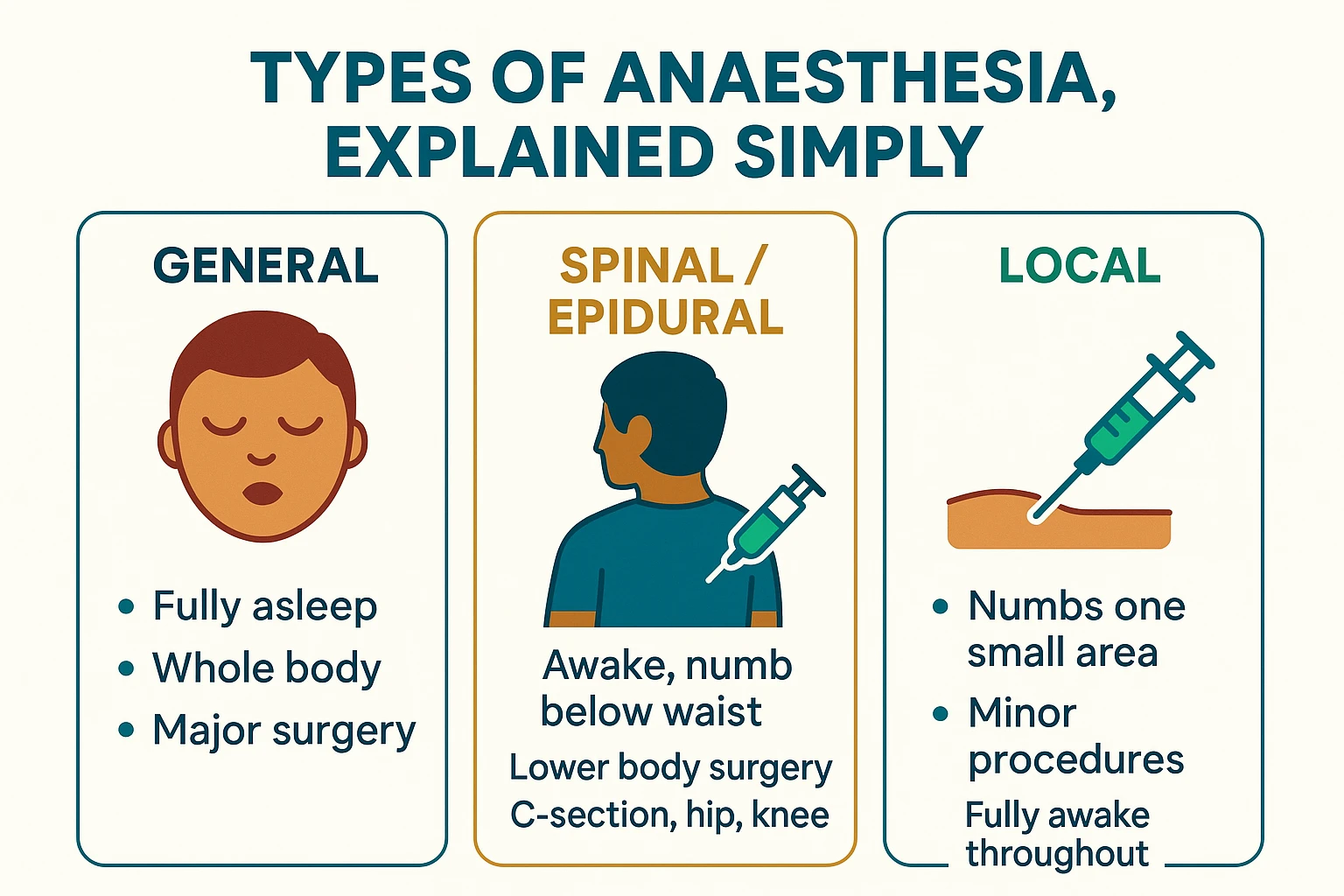
Types of anaesthesia: general, spinal, local comparison infographic
Want to Know Which Anaesthesia Suits Your Surgery?
Our anaesthesiology team will explain the right technique for your specific procedure at your pre-anaesthesia consultation.
📅 Book a Consultation 💬 WhatsApp Us