If a snake bites you or someone near you, the only thing that saves a life is reaching a hospital with anti-venom as fast as possible. Do not cut the wound, do not suck the venom, do not apply a tourniquet. Stay still, stay calm, and get to hospital immediately.
How Dangerous Are Snake Bites in India?
India has one of the highest snake bite death rates in the world. An estimated 58,000 people die from snake bites every year — more than anywhere else on earth. Andhra Pradesh, with its large farming communities, river delta regions, and monsoon-flooded fields, is one of the highest-risk states.
East Godavari and West Godavari districts see significant bites every monsoon season, particularly among agricultural workers, fishermen, and children. Most deaths are caused not by venom alone but by delayed treatment, wrong first aid, and not reaching anti-venom in time.
⏱️ The window that matters: Anti-venom works best within the first 4–6 hours. Every wrong action at the bite site costs minutes from that window.
The Most Dangerous Snakes in Andhra Pradesh
India's Big Four snakes cause the majority of serious bites and deaths, and all four are present in Andhra Pradesh: the Indian Cobra and Common Krait (neurotoxic venom), and Russell's Viper and Saw-scaled Viper (haemotoxic venom).
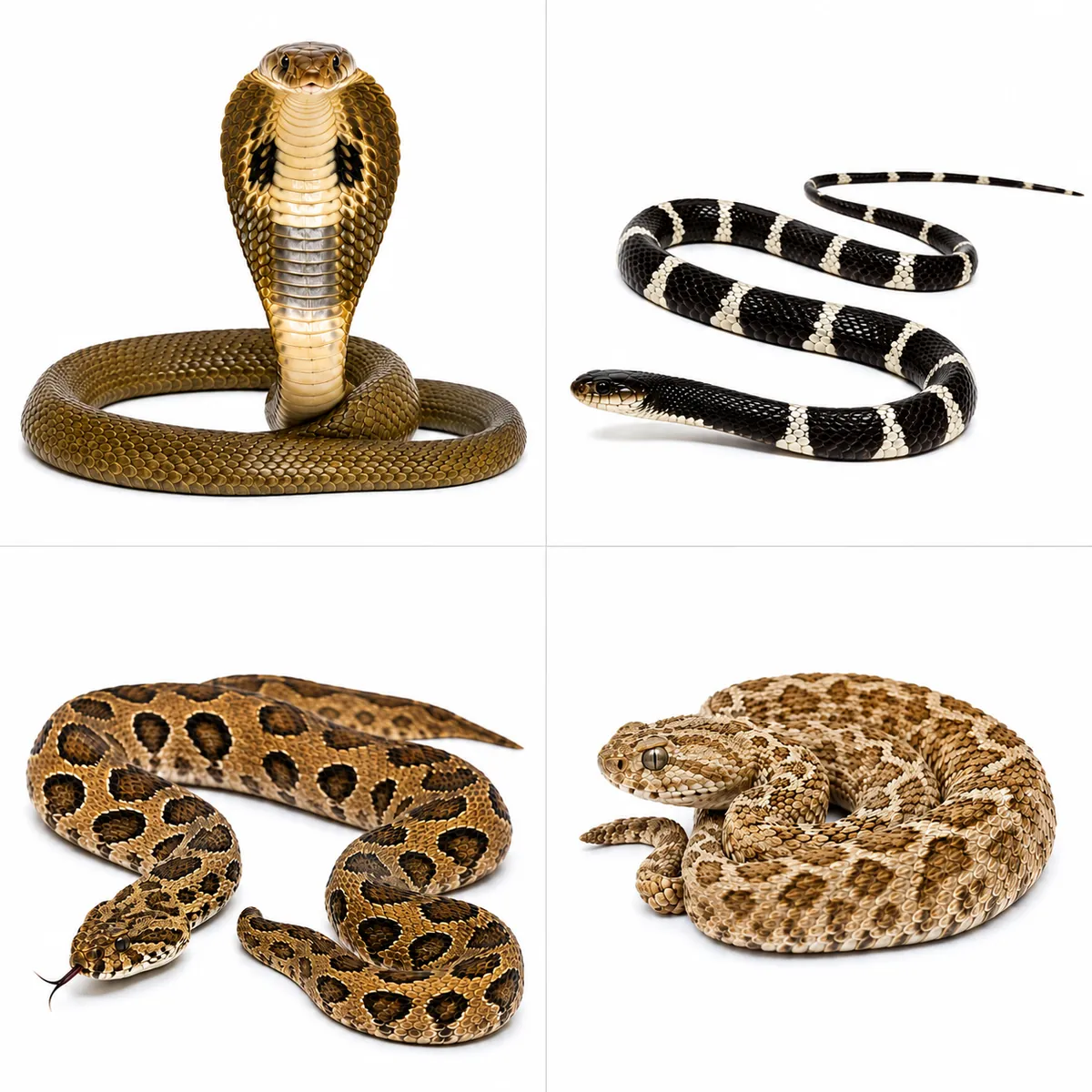
Figure 1: The Big Four. Top-left: Indian Cobra (Naja naja) — neurotoxic. Top-right: Common Krait (Bungarus caeruleus) — neurotoxic. Bottom-left: Russell's Viper (Daboia russelii) — haemotoxic. Bottom-right: Saw-scaled Viper (Echis carinatus) — haemotoxic.
❗ You do not need to identify the snake. Do not attempt to catch or kill it — this causes additional bites. Tell the doctor only what the snake looked like.
What Happens Inside the Body After a Snake Bite
Snake venom is a complex mixture of proteins. Neurotoxic venom attacks the nerve–muscle connection, and can lead to paralysis of the breathing muscles. Haemotoxic venom prevents blood from clotting and can damage the kidneys. Both can be fatal without treatment.
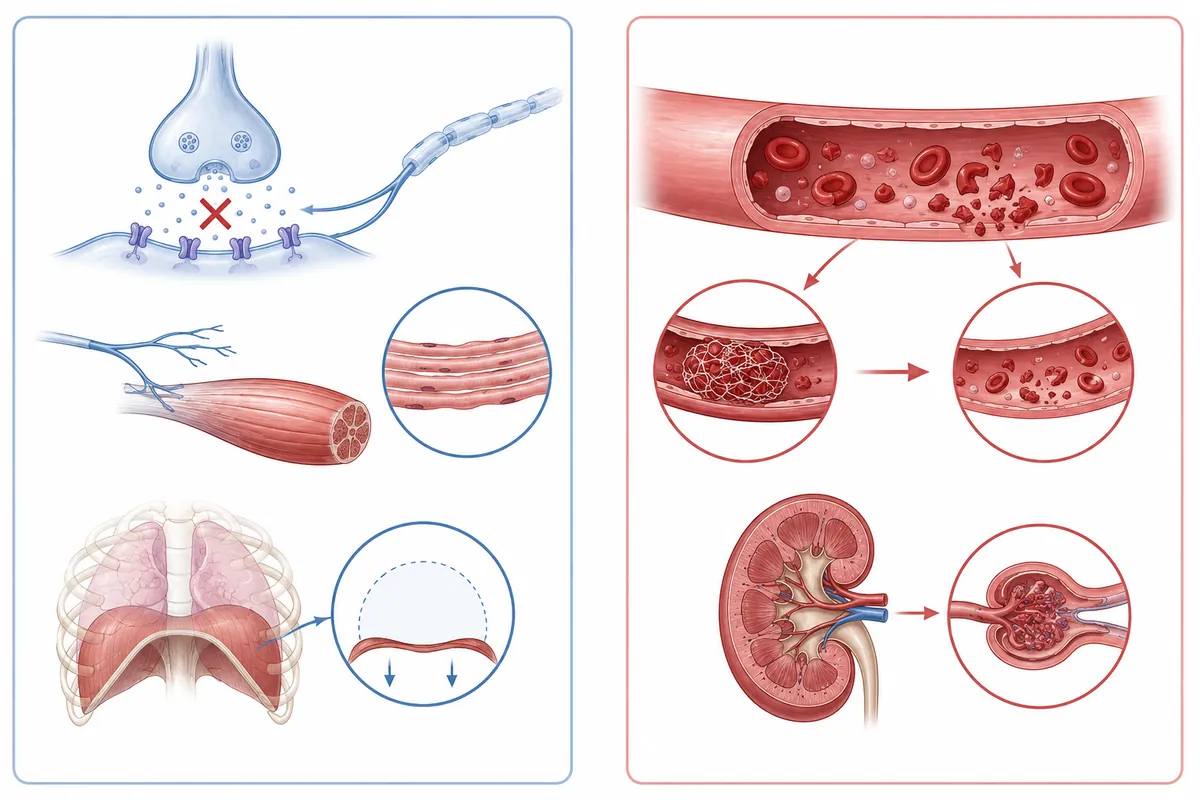
Figure 2: Venom mechanisms. Left: Neurotoxic venom blocks the nerve–muscle synapse, causing diaphragm paralysis and respiratory failure. Right: Haemotoxic venom fragments red blood cells, causes clotting failure, and blocks the kidneys.
Warning Signs of a Serious Snake Bite
Symptoms may appear immediately or take several hours depending on the snake species.
Immediate signs (within minutes)
- Fang marks — one or two small puncture wounds
- Burning or severe pain at the bite site
- Swelling beginning to spread from the bite
- Nausea, vomiting, or dizziness
Neurological signs — cobra or krait bite (may appear 1–6 hours later)
- Drooping eyelids (ptosis) — the clearest early sign of neurotoxic venom
- Difficulty swallowing or slurred speech
- Weakness in the arms and legs
- Difficulty breathing — a life-threatening emergency
Blood signs — viper bite
- Bleeding from gums, nose, or wound that will not stop
- Blood in the urine, or severe swelling spreading rapidly up the limb
- Confusion or loss of consciousness
⚠️ Important
- A painless bite does not mean the snake was harmless. Krait bites are frequently painless. Always go to hospital regardless of how the bite feels.
What To Do Immediately — Six Steps
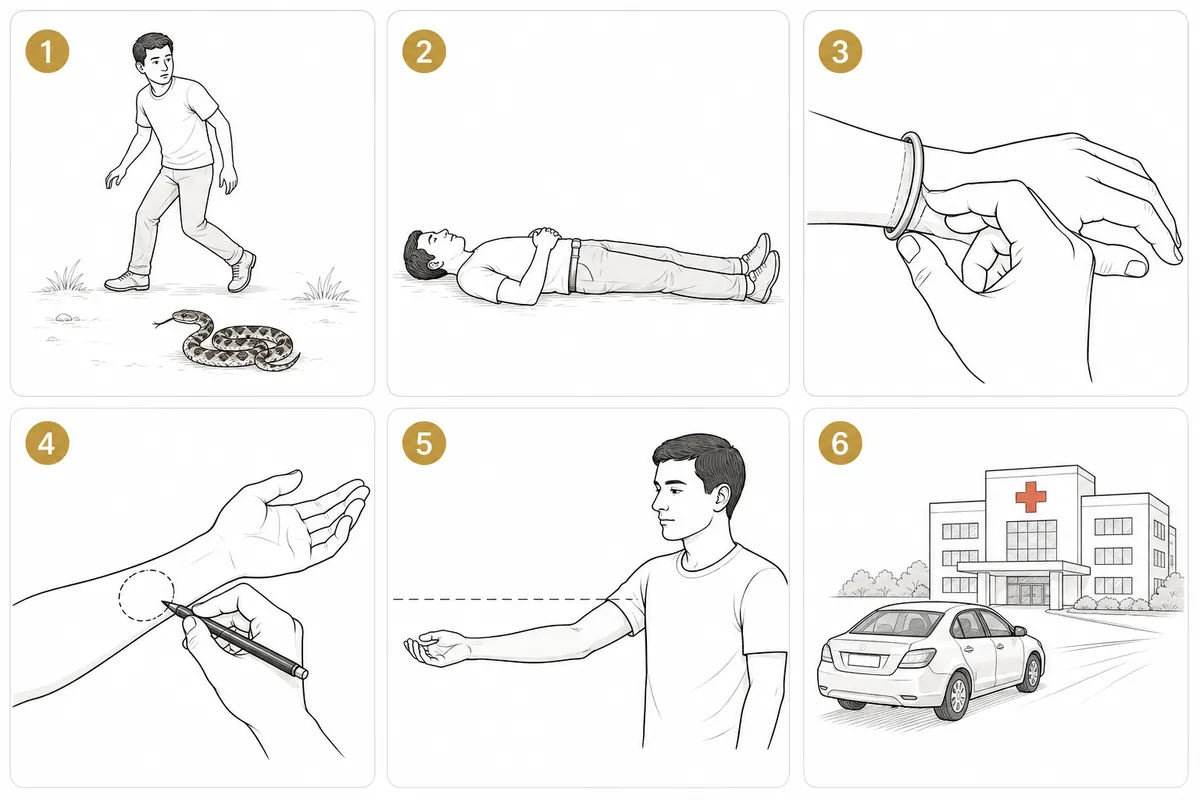
Figure 3: Correct first aid. (1) Move away from the snake. (2) Keep the patient lying still. (3) Remove rings, bangles, and watches near the bite. (4) Mark the swelling boundary with a pen and note the time. (5) Keep the bitten limb below heart level. (6) Get to hospital immediately.
✅ Do These Immediately
- Move away from the snake. Do not try to catch or kill it.
- Keep the patient lying still and calm — movement speeds the spread of venom.
- Remove rings, bangles, and watches near the bite before swelling begins.
- Mark the swelling boundary with a pen and note the time, so doctors can track how fast it spreads.
- Keep the bitten limb below heart level.
- Get to hospital immediately — call 108 or drive to the nearest hospital that carries anti-venom.
🏥 Sri Ganga Emergency & Multispeciality Hospital is open 24 hours, 7 days, and carries anti-venom. Call ahead on 82828 98918 so the emergency team can prepare.
What NOT To Do — These Actions Kill People
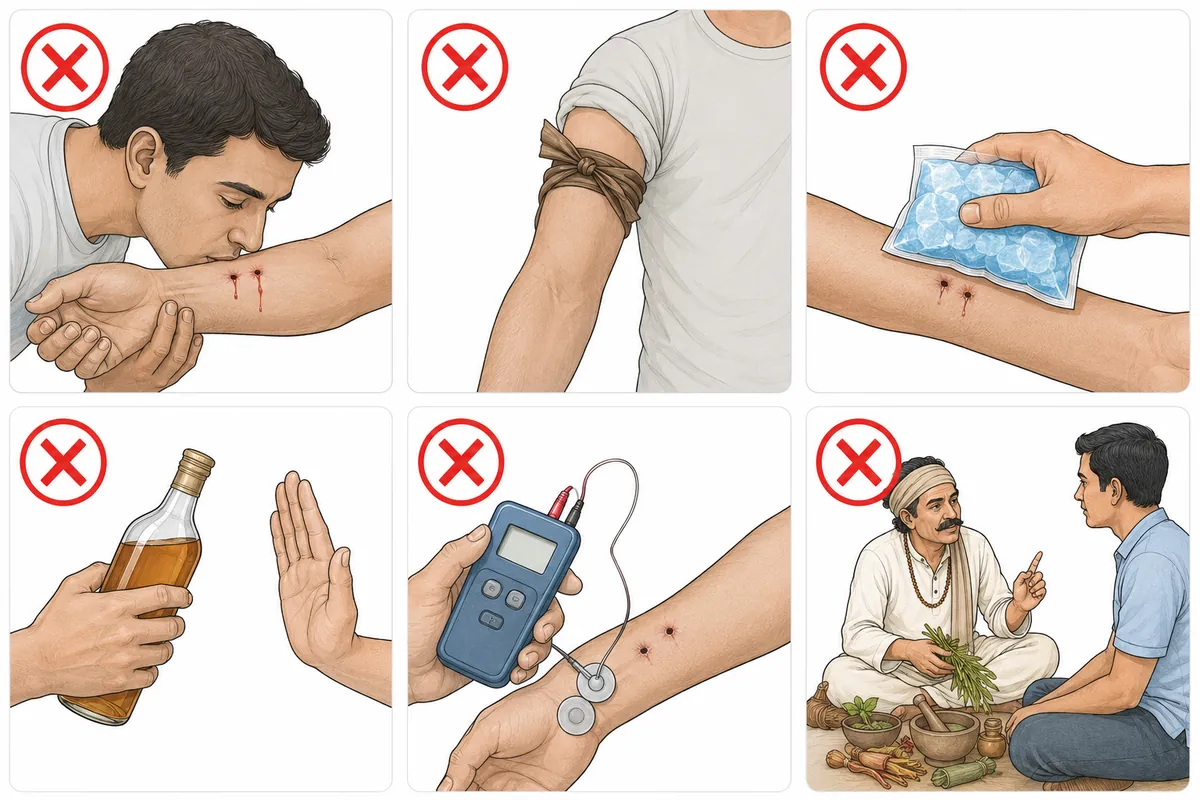
Figure 4: Six dangerous actions that must never be taken after a snake bite.
🚫 Never Do Any of These
- Do not cut and suck the wound — venom reaches the lymphatic system within seconds of the bite.
- Do not apply a tourniquet — it destroys the limb without stopping the venom.
- Do not apply ice to the bite.
- Do not apply any liquid or substance to the wound.
- Do not apply electric shock.
- Do not go to a traditional healer first — every hour lost is an hour without anti-venom.
Common Myths That Cost Lives
Krait bites are frequently painless, and kraits are responsible for a significant number of deaths in Andhra Pradesh. Go to hospital regardless of pain.
These devices have been extensively studied and found completely ineffective. The FDA removed approval for them.
Polyvalent anti-venom works against all four Big Four species. Do not delay to identify the snake — go immediately.
No evidence supports this. The right action is reaching hospital, not trying to stay awake.
How Anti-Venom Works
Anti-venom is produced by injecting small amounts of venom into horses. Their immune systems produce antibodies that neutralise the venom molecules, and these antibodies are extracted and purified into the anti-venom given to patients.
Polyvalent anti-venom — stocked at Sri Ganga Hospital — works against all four Big Four snakes. You do not need to identify the snake for this anti-venom to work.
🔑 The critical fact: Anti-venom cannot reverse damage already done. It can only stop further damage. This is why every minute between bite and hospital matters.
Frequently Asked Questions
You cannot reliably tell from the bite or appearance. Go to hospital for every bite. A 20-minute whole blood clotting test (20WBT) gives a quick indication of haemotoxic venom. Let the doctors test.
Ask immediately and request referral to a hospital that stocks it. Sri Ganga Hospital maintains anti-venom stock — call 82828 98918 ahead of arrival.
In rural areas, do not wait. Drive immediately. Keep the patient lying still with the bitten limb low, and call 108 while driving.
Yes — with fast treatment, the outlook is very good. Children are at higher risk because a smaller body weight means the same venom has a stronger effect. Speed is even more critical for a bitten child.
Tell the doctor: (a) the time of the bite, (b) where on the body, (c) what the snake looked like, (d) any actions taken since the bite, and (e) the symptoms and when they started.
Neurotoxic bites treated promptly usually recover in about 24–72 hours, with ventilator support if needed. Haemotoxic bites need kidney function monitored and can take days to weeks. Early treatment dramatically improves outcomes.
🔑 Key Takeaways
- Anti-venom in a hospital is the only thing that saves a life — reach one fast
- Never cut, suck, tie a tourniquet, apply ice, or visit a healer first
- A painless bite is not a safe bite — krait bites often hurt very little
- You do not need to identify the snake; polyvalent anti-venom covers all Big Four
"In snake bite, most deaths come not from venom alone but from delay and wrong first aid. Stay calm, keep still, and reach a hospital with anti-venom — that single decision saves lives."— Dr. Chaitanya Pilladi, Consultant Anaesthesiologist, Sri Ganga Hospital
Sri Ganga Hospital — 24/7 Snake Bite & Toxicology Care
Sri Ganga Hospital, Rajahmundry provides round-the-clock snake bite and poisoning treatment with polyvalent anti-venom, ventilator support, and ICU backup. If you or someone near you is bitten, do not delay — call ahead so our emergency team can prepare.
🚨 Call Emergency: +91-8282 8989 18 📅 Book a ConsultationMedical disclaimer: This article is for general health education only. It does not constitute medical advice and is not a substitute for professional medical evaluation. Snake bites are medical emergencies — always seek immediate emergency care. Sri Ganga Emergency & Multispeciality Hospital is available 24×7.
References: Warrell DA. Guidelines for the Management of Snake-bites. WHO SEARO, 2nd edition, 2016. · ICMR. Standard Treatment Guidelines: Snake Bite. Ministry of Health and Family Welfare, Government of India. · IAMH. Consensus Guidelines on Management of Snake Bite in India, 2021. · Mohapatra B et al. Snakebite mortality in India: a nationally representative mortality survey. PLOS NTD, 2011.