Keep the accident victim still, call for help immediately at +91-8282 8989 18 or 108, control any bleeding with firm pressure, and never move them, remove their helmet, or give them water. India's Good Samaritan Law protects you legally when you help in good faith — hesitating costs lives, not helping.
Every year, thousands of accident victims on India's roads lose their lives not from the crash itself, but from what happens — or doesn't happen — in the minutes right after it. You don't need to be a doctor to make a difference. You just need to know the right first steps, and avoid the wrong ones.
What this guide covers
The First 60 Seconds
✅ Do this first, in order
- Make sure the scene is safe before you approach — switch on hazard lights, place warning triangles or branches behind the vehicle, and keep other traffic from adding a second accident to the first.
- Call for help immediately — dial 108 for an ambulance, or call Sri Ganga Hospital's emergency line directly at +91-8282 8989 18. Give your exact location — a nearby landmark, milestone, or shop name helps responders reach faster.
- Check if the person is conscious and breathing. Speak to them, gently tap their shoulder. If they respond, stay with them and keep them calm.
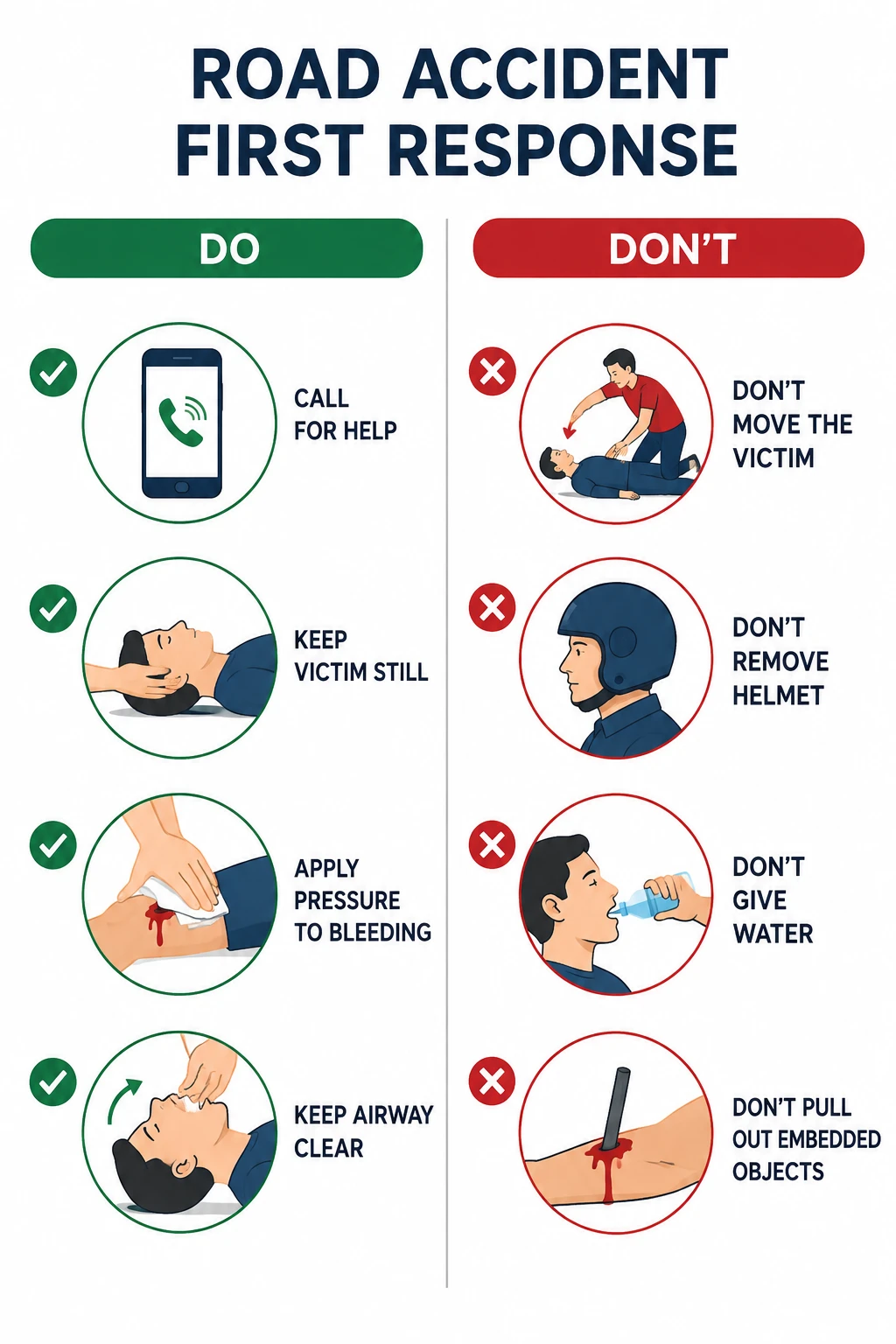
What to do — and what never to do — in the minutes after a road accident.
What You Should Do
- Keep the person still. Do not let them sit up, walk, or "shake it off," even if they insist they're fine — spinal and internal injuries are often not visible.
- Control visible bleeding by pressing a clean cloth firmly on the wound. Keep pressing until help arrives.
- Keep the airway clear if the person is unconscious — gently tilt the head back if there's no suspicion of a neck injury.
- Keep them warm with a blanket or cloth — shock can set in quickly even without visible severe injury.
- Note the time of the accident. This matters for the treating doctors.
What You Should NEVER Do
🚫 Avoid these — they can cause real harm
- Do not move the victim unless there is an immediate danger (fire, oncoming traffic, submerged vehicle). Moving a person with a spinal injury can cause permanent paralysis.
- Do not remove a helmet forcefully from a two-wheeler rider — this can worsen a neck or head injury. Leave it for trained responders unless the person is not breathing.
- Do not give water, food, or anything to eat or drink — the person may need emergency surgery, and an empty stomach matters.
- Do not pull out any object stuck in the body (glass, metal, wood). Removing it can cause severe bleeding. Stabilize it in place and let the hospital handle it.
- Do not crowd the victim. A tight circle of onlookers blocks air and blocks the ambulance from reaching them.
The Golden Hour
Trauma specialists call the first hour after a serious injury the "golden hour" — the window where prompt action has the biggest impact on survival and recovery. What a bystander does in this window, before any doctor arrives, genuinely changes outcomes.
"The difference between a good recovery and a permanent disability often comes down to what happens in the first few minutes, before an ambulance even arrives. Bystanders are the real first responders."— Dr. Chaitanya Pilladi, Consultant Anaesthesiologist & Intensivist
You Are Legally Protected — The Good Samaritan Law
Many people hesitate to help, fearing police harassment or legal trouble. Under India's Good Samaritan Law (notified by the Ministry of Road Transport and Highways), anyone who helps an accident victim in good faith — including taking them to a hospital — cannot be forced to reveal their name, held liable, or detained for questioning as a witness unless they choose to give a statement voluntarily.
Helping is protected. Hesitating costs lives.
When to Head Straight to the Hospital
Do not wait for a "second opinion" or for symptoms to worsen at home. Bring the person to the nearest equipped emergency department — such as Sri Ganga Hospital's 24×7 trauma-ready emergency unit — immediately if there is:
- Heavy or uncontrolled bleeding
- Loss of consciousness, even briefly
- Difficulty breathing
- Visible deformity, or inability to move a limb
- Confusion, vomiting, or severe headache after a head injury
Key takeaways
- Scene safety first, then call for help — 108 or +91-8282 8989 18
- Keep the victim still; never move them unless in immediate danger
- Never remove a helmet, give water, or pull out embedded objects
- You are legally protected under the Good Samaritan Law
- The first hour genuinely changes survival and recovery outcomes
This guide is for general awareness and does not replace professional medical care or trained first-aid instruction. In any road accident, call for emergency help immediately and get the injured person to a hospital as soon as possible.
- Ministry of Road Transport and Highways, Government of India. Good Samaritan Guidelines, 2015.
- World Health Organization. Global status report on road safety 2023.
- National Health Mission, MoHFW. Emergency Medical Services (108) Guidelines.
- American College of Surgeons Committee on Trauma. Advanced Trauma Life Support (ATLS).
Sri Ganga Hospital Is Ready, Day or Night
Our emergency team is equipped and available 24×7 for trauma cases, with rapid triage and on-call surgical support. In an accident, every minute counts — save our number and don't hesitate to call.
🚨 Call +91-8282 8989 18 📅 Book an AppointmentRelated reading: 24×7 Emergency Care in Rajahmundry — Complete Patient Guide