A child's body is not a small version of an adult's — and pediatric surgical problems need a pediatric surgeon's eye to spot them early and treat them right.
From a swelling in the groin that appears only when a baby cries, to a scan finding during pregnancy, to a teenager doubled over with sudden groin pain — pediatric surgery and pediatric urology cover a wide, often worrying, range of conditions. Most are far more common, and far more treatable, than parents expect.
This guide brings together the conditions we see most often in children across the Godavari region, explains what each one actually means, and tells you clearly when it is safe to watch and wait — and when you need to see a pediatric surgeon without delay.
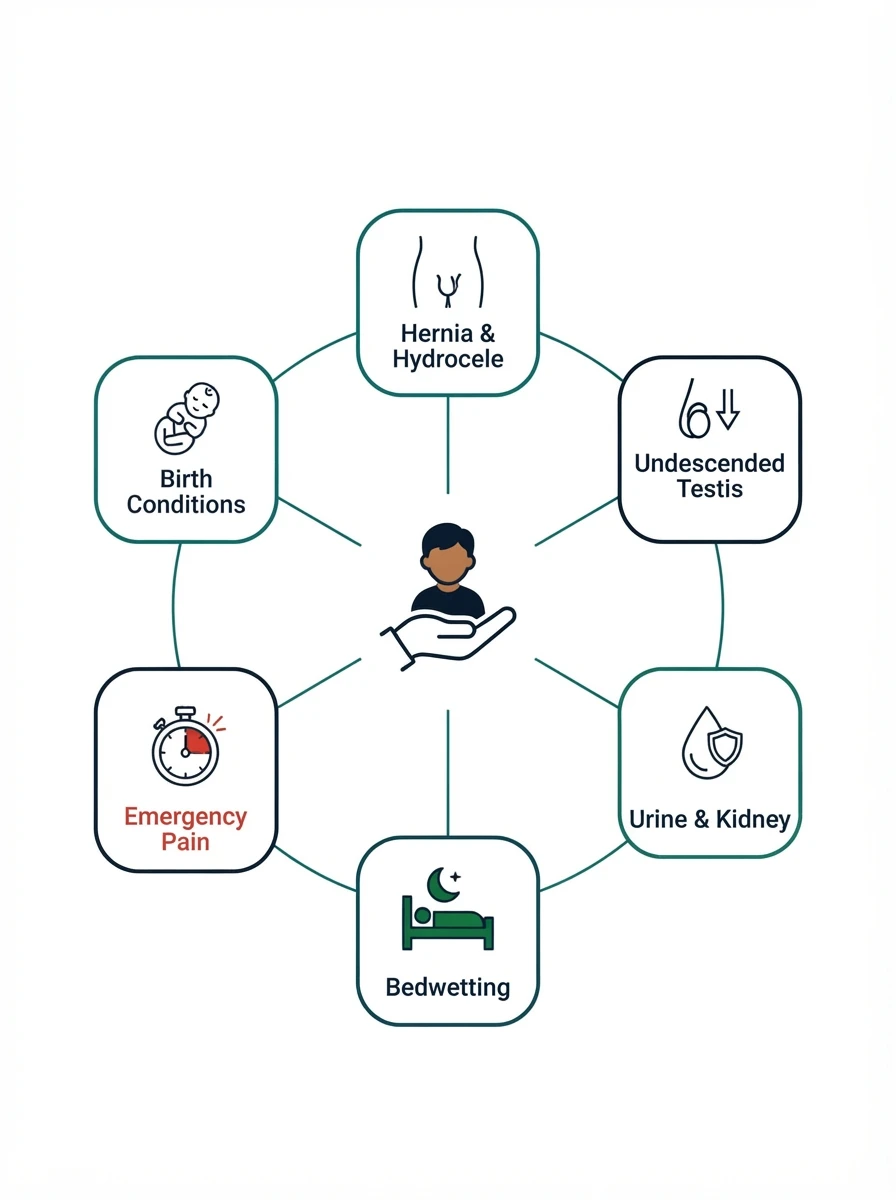
Common pediatric surgical and urology conditions parents should recognise early.
Why Pediatric Surgery Is Its Own Specialty
Children are not simply smaller patients. Their anatomy, physiology, anaesthesia requirements and healing patterns are all different from an adult's, and many conditions — hernias, undescended testis, hypospadias, congenital anomalies — occur only, or mostly, in childhood.
A pediatric surgeon and pediatric urologist trains specifically to diagnose and operate on infants, children and teenagers, using techniques, instruments and anaesthesia protocols suited to a growing body. This is why timing, technique and follow-up all matter more in a child than they might in an adult with a similar-sounding problem.
Inguinal Hernia & Hydrocele — The Most Common Childhood Surgery
A soft swelling in the groin or scrotum that comes and goes — often more noticeable when the baby cries or strains — is usually an inguinal hernia or a hydrocele. Both happen because of a small passage from before birth that has not closed properly.
- Hydrocele — fluid collects around the testis; many resolve on their own in the first year of life
- Inguinal hernia — a loop of intestine or tissue slips through the passage; this does not resolve on its own and needs surgical repair
A hernia that suddenly becomes firm, painful, and will not go back in is an emergency — it can mean the intestine is trapped. Seek urgent care rather than waiting for a routine appointment.
Undescended Testis (Cryptorchidism) — Why Timing Matters
Normally, both testes descend into the scrotum before or shortly after birth. When one or both do not, it is called an undescended testis. It is common in premature babies and often resolves in the first few months — but if it has not by around 12-18 months of age, surgery (orchidopexy) is recommended.
Correcting it at the right age matters for two reasons: it lowers the long-term risk to fertility, and it allows easier self-examination and monitoring in adulthood. Waiting too long does not "give it more time" — it simply narrows the window for the best outcome.
Phimosis & Circumcision — When It's Medical, Not a Preference
A foreskin that cannot be fully retracted is normal in most young boys and usually loosens naturally over the first several years. It becomes a medical concern only when there is recurrent infection, ballooning during urination, scarring, or pain — and in those cases, treatment (which may include circumcision) is a medical decision made with a pediatric urologist, not a routine or cultural one.
Hypospadias — A Birth Condition Worth Recognising Early
In hypospadias, the urinary opening is not at the tip of the penis but somewhere along its underside — a condition present from birth. It is usually noticed at the newborn check or soon after. Surgical correction, typically performed between roughly 6 months and 2 years of age, restores normal urinary function and appearance, and outcomes are generally excellent when treated at the right time by an experienced pediatric urologist.
Do not circumcise a baby with suspected hypospadias before a pediatric urology opinion — the foreskin is sometimes needed for the repair itself.
Umbilical & Abdominal Wall Hernias in Babies
A soft bulge at the belly button that gets more prominent when a baby cries is usually an umbilical hernia. The great majority close on their own by age 4-5 and need no treatment at all. Surgery is considered only if the hernia is unusually large, persists beyond that age, or becomes painful.
Urinary Tract Infections & Vesicoureteral Reflux (VUR)
A child with unexplained fever, poor feeding, or recurrent urine infections may have an underlying urinary problem rather than a simple infection. Vesicoureteral reflux — where urine flows backward toward the kidney — is one such cause, found through a urine culture and imaging after a first significant UTI in a young child.
Most grades of VUR are managed conservatively with monitoring and, where needed, preventive antibiotics, and many children outgrow it. The goal of early evaluation is simple: protect the kidneys from repeated infection while the reflux resolves on its own.
Antenatally Detected Kidney Swelling (Hydronephrosis)
Many parents first hear the word "hydronephrosis" on a routine pregnancy scan, and it understandably causes alarm. In most cases, mild antenatal hydronephrosis resolves on its own after birth and needs only a follow-up ultrasound. A pediatric urology review after delivery decides whether further tests are needed, and only a minority of cases require any intervention.
Bedwetting Beyond Age 5
Occasional bedwetting is normal well into the early school years. It becomes worth a pediatric urology assessment when it continues regularly past age 5-6, or restarts after a long dry period — since an underlying cause, when found, is usually straightforward to treat.
Testicular Torsion — The Emergency Parents Must Never Ignore
Sudden, severe pain in the testicle or groin in a boy of any age is a surgical emergency. Testicular torsion cuts off the blood supply to the testis, and the "golden window" to save it is only a few hours from when the pain starts.
Do not wait to see if the pain settles, and do not treat it as a routine ache. Go to the emergency department immediately — every hour of delay reduces the chance of saving the testis.
Appendicitis in Children
Appendicitis can look different in a child than in an adult — pain may be vague, centred around the navel rather than the lower right abdomen, and accompanied by reduced appetite, fever, or vomiting, which sometimes delays diagnosis. Any child with persistent abdominal pain, especially with fever or vomiting, should be examined promptly rather than watched at home for more than a few hours.
Neonatal Surgical Emergencies
A small number of babies are born with conditions — such as intestinal blockage, a diaphragm defect, or an abdominal wall anomaly — that require surgery within hours or days of birth. These are identified either on antenatal scans or by specific warning signs after birth: repeated vomiting (especially green/bile-stained), a swollen abdomen, or failure to pass the first stool. Any of these in a newborn needs immediate medical attention.
Preparing Your Child for Surgery
When surgery is planned, a pre-anaesthesia check, exact fasting instructions by age and weight, and a simple, honest explanation to the child (age-appropriate) all make the day easier. Pediatric anaesthesia is dosed precisely by weight and continuously monitored, and a parent can usually stay with the child until they are asleep and be present again as soon as they wake.
Pediatric Surgery & Urology at Sri Ganga Hospital
Dr. Venkatesh Kolla brings dedicated M.Ch. training in Pediatric Surgery, along with advanced fellowship training in minimal-access pediatric urology and pediatric thoracoscopic surgery, to Sri Ganga Emergency & Multispeciality Hospital, Rajahmundry. Along with round-the-clock emergency cover, dedicated pediatric anaesthesia support, and a trained nursing team, Sri Ganga provides comprehensive pediatric surgical and urology care for families across the Godavari region — from routine day-care procedures to true surgical emergencies.
Dr. Venkatesh Kolla practices across more than one hospital in the region; please call or WhatsApp to confirm his consulting day at Sri Ganga before your visit.
Concerned About Your Child? Talk to Our Pediatric Surgeon.
Dr. Venkatesh Kolla and the team at Sri Ganga Hospital, Rajahmundry are here to examine, explain, and guide you on the right next step for your child.
📅 Book a Consultation 💬 WhatsApp Us