Check if your child is alert, drinking fluids, and responsive between fever spikes — if so, home care is usually appropriate. But if your child is under 3 months old, has had a seizure, is difficult to wake, or is struggling to breathe, come to Sri Ganga Hospital immediately or call +91-8282 8989 18. We are open 24×7.
Every parent knows this moment — your child feels warm, the thermometer confirms it, and suddenly the evening revolves around one question: is this just a viral fever, or something that needs a doctor right now? Most childhood fevers are the body's normal, healthy response to a common infection and settle with simple home care. A small number are the first sign of something more serious. This guide helps you tell the difference calmly, without guesswork.
What this article covers
- What counts as fever in a child
- Safe home care for a well-behaving fever
- When to rush to the hospital immediately
- Age matters: fever in babies under 3 months
- Febrile seizures — what every parent should know
- Monsoon & winter: why fevers spike in Rajahmundry
- What happens when you arrive at Sri Ganga
- Frequently asked questions
What Counts as Fever in a Child
A child is considered to have fever at a temperature of 100.4°F (38°C) or above, measured rectally in infants or under the tongue or in the armpit for older children. It's worth remembering: how high the fever is does not always tell you how serious the illness is.
A short-lived high fever from a common viral infection can look dramatic — a flushed face, a hot forehead, a child who wants to be held constantly — and still settle within a day or two with simple care. Meanwhile, a lower-grade fever accompanied by certain warning signs can need urgent attention. This is why doctors always ask about the accompanying symptoms, not just the number on the thermometer.
🌡️ Fever itself is not the enemy. It is the body's immune system working — raising core temperature to fight infection more effectively. The goal of home care is comfort and hydration, not forcing the number down as fast as possible.
Safe Home Care for a Well-Behaving Fever
If your child is alert, drinking fluids, and responsive between fever spikes — even if cranky or tired — home care is usually appropriate.
✅ What actually helps
- Fluids first. Breast milk or formula for infants; water, ORS, or coconut water for older children. Dehydration is the biggest home-care risk — not the fever itself. Offer fluids often, in small amounts if the child is reluctant.
- Dress light. Avoid heavy blankets or extra layers. Light clothing helps the body release heat naturally — bundling up traps it in.
- Lukewarm sponging for comfort. A lukewarm — never cold or ice — sponge bath can help your child feel more comfortable. Cold water can cause shivering, which actually raises core temperature further.
- Rest. Let your child sleep and rest as needed. There's no need to force normal play or activity.
- Keep the room comfortable. A well-ventilated, moderately cool room helps more than a sealed, overheated one.
💊 On medicine: Only give fever-reducing medicine that your child's pediatrician has specifically advised, at the dose prescribed for your child's exact weight and age. Never estimate a dose based on age alone, and never repeat a dose earlier than advised. If your child hasn't been prescribed fever medicine before, check with a doctor before giving anything.
When to Rush to the Hospital Immediately
Some signs mean it's time to stop watching and start moving. Go to the emergency room right away — don't wait it out at home — if your child has fever and any of the following:
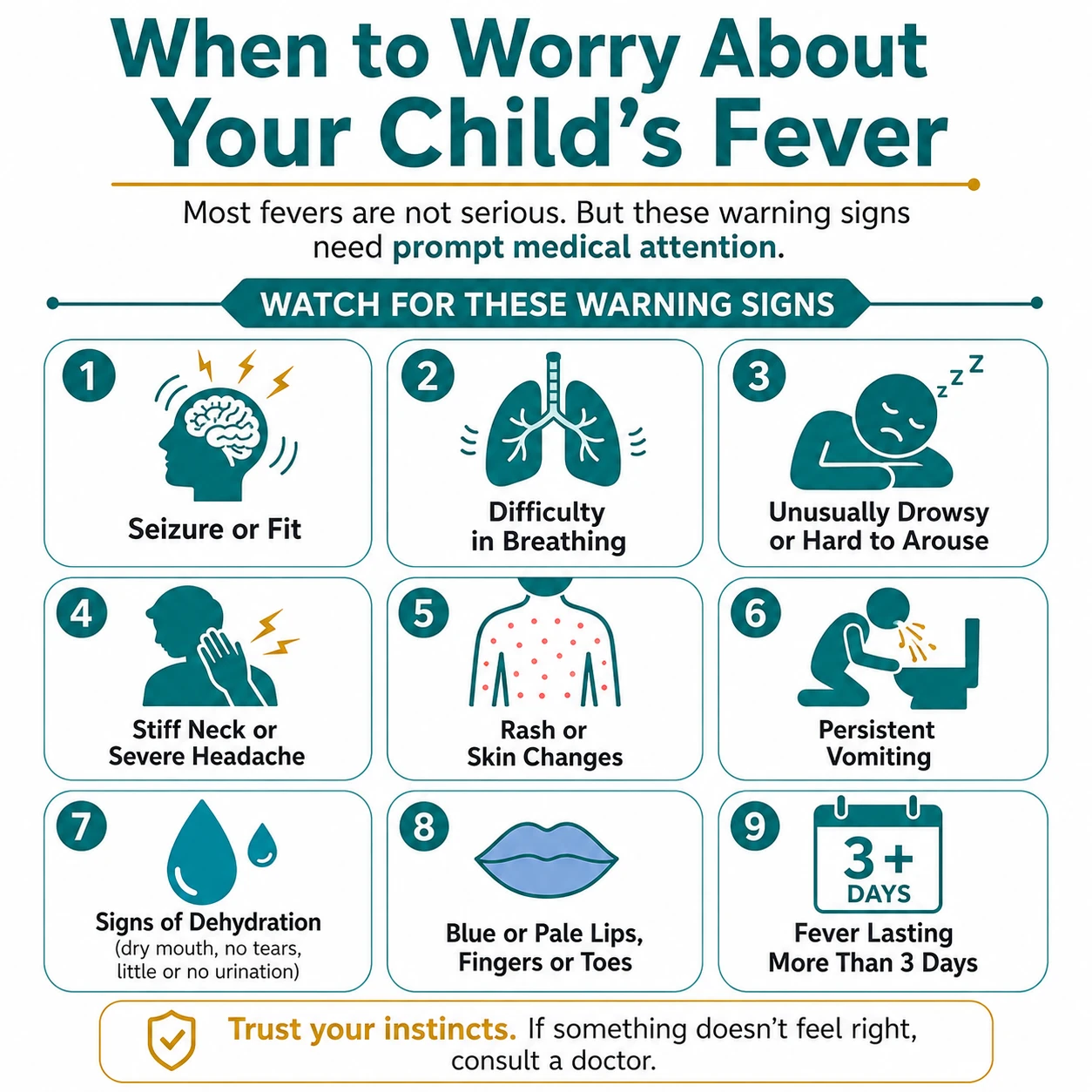
Figure 1: Warning signs that mean your child's fever needs urgent medical attention. If even one sign is present, don't wait for the others to appear — call +91-8282 8989 18 or come in.
⚠️ Red-flag signs — go to hospital now, or call ahead
- A seizure or fit — even a brief one
- Difficulty breathing — fast breathing, chest pulling in with each breath, grunting, or visible breathlessness
- Unusual drowsiness — hard to wake up, or unusually limp and unresponsive between fever spikes
- Stiff neck, especially together with headache or sensitivity to bright light
- A rash that doesn't fade when you press a glass firmly against it
- Persistent vomiting or inability to keep any fluids down
- Signs of dehydration — no wet nappy or urination for 8+ hours, dry lips, sunken eyes, no tears when crying
- Bluish lips, face, or fingertips
- Fever lasting more than 3 days without improvement, even if the child otherwise seems okay
If your child shows any of these signs, don't wait to see if things improve. Come in, or call +91-8282 8989 18 first if you're unsure — calling ahead means the team can guide you and prepare before you arrive.
Age Matters: Fever in Babies Under 3 Months
A young infant's fever is treated differently from an older child's — and for good reason. Babies under 3 months have immune systems that are still developing, and they can deteriorate quickly even when the first signs look mild.
👶 Age-based urgency — know the difference
Any fever needs same-day medical evaluation — regardless of how the baby otherwise looks or behaves. Do not wait for other symptoms to appear. This age group is treated as urgent by default.
Home care with close monitoring is usually reasonable if the child is alert and feeding well — but seek same-day care if fever persists beyond 24–48 hours or any red-flag sign appears.
Home care is usually appropriate if the child is alert and drinking fluids well. Seek care if fever lasts more than 3 days, keeps returning, or any red-flag sign appears.
Febrile Seizures — What Every Parent Should Know
A fever-triggered seizure is one of the most frightening things a parent can witness — the child's body stiffens or jerks, eyes may roll back, and for a few seconds or minutes it can feel like the longest moment of your life.
🌀 The reassuring part — and the part that still needs a doctor
Febrile seizures are common — they affect a meaningful proportion of children between 6 months and 5 years, and most are brief, lasting under 5 minutes, with no lasting harm.
Even so, every febrile seizure — even a short one — should be evaluated by a doctor the same day. This is not because the seizure itself is usually dangerous, but to rule out other causes and make sure your child is checked safely.
During a seizure: keep your child safe from injury, turn them gently onto their side, do not put anything in their mouth, and time how long it lasts. If it continues beyond 5 minutes, or your child does not return to normal breathing and consciousness afterward, treat it as an emergency and call +91-8282 8989 18 immediately.
Monsoon & Winter: Why Fevers Spike in Rajahmundry
Childhood fevers tend to peak during the monsoon and winter months, when viral infections circulate more widely through schools, playgroups, and households. Monsoon season carries an additional consideration for parents in and around Rajahmundry: it's also vector-borne illness season.
🦟 During monsoon specifically, be extra alert if fever comes with severe body aches, a skin rash, or bleeding gums. These can be signs of vector-borne illness, and warrant a lower threshold for getting your child checked — sooner rather than waiting it out at home.
What Happens When You Arrive at Sri Ganga
If you do need to bring your child in, here's what to expect:
- Immediate assessment — our emergency team evaluates your child's breathing, alertness, hydration, and vital signs right away.
- Stabilisation first — the priority is always to stabilise your child before anything else, including paperwork.
- Pediatric consultation — our emergency team stabilizes your child and consults or refers to a pediatrician as needed, so the right specialist input is part of the care plan.
- Tests as needed — blood tests or other investigations are used to identify the cause of fever when the picture isn't straightforward.
- Clear guidance before you leave — you'll know exactly what to watch for at home and when to come back.
For the full picture of our emergency room process — triage, stabilisation, admission decisions — see our 24×7 Emergency Care Complete Patient Guide.
Frequently Asked Questions
No. The height of the fever doesn't reliably indicate how serious the illness is. Accompanying symptoms and your child's overall behaviour matter more than the number on the thermometer.
Only give medicine and doses your pediatrician has specifically advised for your child's exact weight and age — never estimate a dose yourself.
Any fever in an infant under 3 months old needs same-day medical evaluation, regardless of how the baby otherwise seems.
A seizure triggered by a rapid rise in temperature, most common between 6 months and 5 years. Most are brief and not harmful long-term, but every one needs same-day medical evaluation.
A seizure, difficulty breathing, unusual drowsiness, stiff neck, a non-fading rash, persistent vomiting, signs of dehydration, bluish lips or face, or fever lasting more than 3 days.
Viral infections circulate more widely in these months, and monsoon season adds vector-borne illness risk — be extra alert for fever with body aches, rash, or bleeding gums.
There's no fixed amount — offer fluids often and watch for signs of good hydration like regular urination and alertness. If your child refuses fluids repeatedly, seek medical care.
🔑 Key Takeaways
- Fever height alone doesn't predict severity — watch your child's behaviour and accompanying signs
- Fluids, light clothing, rest, and lukewarm comfort measures are the safe home-care basics
- Any fever in a baby under 3 months needs same-day evaluation, no matter how the baby looks
- Seizure, breathing difficulty, unusual drowsiness, stiff neck, non-fading rash, persistent vomiting, dehydration signs, or bluish lips mean go to hospital now
- Febrile seizures are common and usually not dangerous — but always need same-day evaluation
- Monsoon and winter bring more fevers — monsoon adds vector-borne illness risk
- Never give fever medicine except as specifically prescribed by your pediatrician for your child's weight and age
- When in doubt, call +91-8282 8989 18 — we're open 24×7
"Parents almost always know when something is different about their child — trust that instinct. Most fevers in children are the body doing exactly what it should. Our job is to help parents tell the difference between 'this needs rest and fluids' and 'this needs us to look at your child right now' — without fear, and without guesswork."— Dr. Chaitanya Pilladi, Consultant Anaesthesiologist & Intensivist, Sri Ganga Hospital
Worried About Your Child's Fever? Sri Ganga Hospital — 24×7 Emergency Care in Rajahmundry
Our emergency team stabilizes your child and consults or refers to a pediatrician as needed. Call ahead if you're unsure, or come in directly — every reassurance matters.
🚨 Call Emergency: +91-8282 8989 18 📅 Book a Pediatric ConsultationMedical disclaimer: This article is for general health education only and does not constitute medical advice. It is not a substitute for professional medical evaluation. If you are concerned about your child's fever, call +91-8282 8989 18 or bring your child to the nearest emergency department — do not wait. Sri Ganga Emergency & Multispeciality Hospital is open 24×7.
- Indian Academy of Pediatrics. Guidelines on Fever Management in Children.
- World Health Organization. Integrated Management of Childhood Illness (IMCI) Guidelines. who.int
- American Academy of Pediatrics. Fever in Children: Parent FAQs. healthychildren.org
- National Health Mission, Ministry of Health & Family Welfare, Government of India. Febrile Illness Management Guidelines.