Call +91-8282 8989 18 immediately. Do not drive yourself. Keep the patient calm and still. Do not give food, water, or any medication. Sri Ganga Hospital is open 24×7 — calling ahead means the team is ready when you arrive.
A heart attack does not always feel like the movies. It is not always a dramatic collapse with crushing chest pain. Sometimes it is a strange ache in the jaw. Sometimes it is breathlessness and a cold sweat. Sometimes it is extreme tiredness that does not make sense. Knowing the full range of warning signs — and what to do in the first minutes — is the difference between a good outcome and a devastating one.
What this article covers
- Why minutes matter — the science in plain language
- The full warning sign spectrum
- Women and diabetics present differently
- Heart attack vs acidity — quick clarity
- What to do in the first minutes
- What never to do
- What happens when you arrive at Sri Ganga
- Know if you are in the high-risk group
- Frequently asked questions
Why Minutes Matter — The Science in Plain Language
The heart is a muscle. Like every muscle in the body, it needs a constant blood supply to survive. A heart attack happens when one of the arteries supplying blood to the heart gets blocked — usually by a clot forming on a fatty deposit inside the artery wall. The moment blood stops flowing, the heart muscle in that region begins to die.
This is not a slow process. Heart muscle that is starved of blood begins to suffer damage within 20 to 40 minutes. After 6 to 12 hours, the damage in the affected area is largely permanent. This is why cardiologists use the phrase "time is muscle" — every minute between the blockage and the opening of the artery is heart muscle lost.
The outcome of a heart attack is largely decided not in the operating theatre, but in the minutes before the patient reaches the hospital. A patient who recognises the signs early, calls immediately, and reaches an equipped emergency facility within the first hour has dramatically better odds than one who waits two hours hoping the feeling passes.
🕐 The golden hour. Reaching emergency care within the first hour of symptoms gives the best chance of limiting heart muscle damage and avoiding life-threatening complications. Every 30 minutes of additional delay significantly worsens outcomes. Do not wait to see if it gets better.
The Full Warning Sign Spectrum
Most people know about chest pain — but limiting awareness to chest pain alone means missing a large number of real heart attacks. The heart and its surrounding structures share nerve pathways with many parts of the upper body, which is why pain radiates far from the chest itself. Here is the complete picture:
🚨 Warning signs — take any combination seriously
- Chest pain, pressure, tightness, or heaviness — often described as a weight on the chest, a squeezing sensation, or a band being tightened around the chest. It may be constant or come and go.
- Pain spreading to the left arm — the most well-known sign, but the arm may feel heavy, numb, or aching rather than sharply painful.
- Jaw or neck pain — an aching or tightness in the jaw, teeth, or throat, especially without an obvious dental cause and combined with other symptoms.
- Pain between the shoulder blades or upper back — more common in women; often dismissed as a muscle problem.
- Shortness of breath — difficulty breathing with minimal or no exertion, especially when combined with chest discomfort.
- Cold sweat — breaking into a sweat that feels cold and clammy, without obvious reason.
- Nausea or vomiting — stomach discomfort or the urge to vomit, which is frequently mistaken for food poisoning or acidity.
- Sudden, extreme fatigue — an overwhelming tiredness that comes on without explanation, particularly in women; sometimes described as "the most tired I have ever felt."
- Lightheadedness or near-fainting — dizziness or a feeling that you are about to black out.
- A sense that something is very wrong — many heart attack survivors describe a feeling of dread or impending doom that they cannot explain. Do not ignore this.
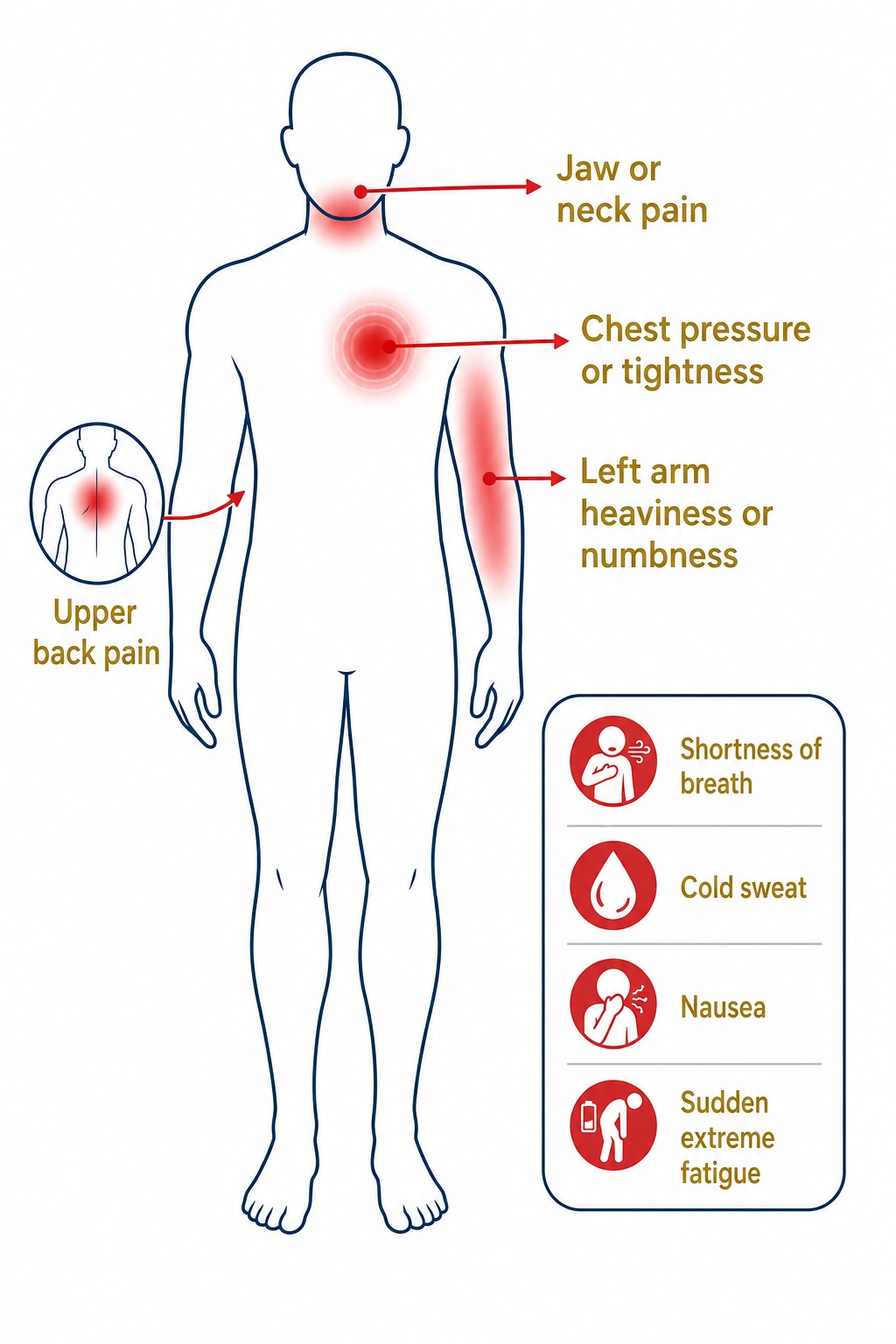
Figure 1: The warning signs of a heart attack extend well beyond chest pain. Women and diabetic patients in particular may experience jaw pain, upper back pain, or extreme fatigue without any chest discomfort at all.
No single symptom makes a heart attack certain or rules it out. What matters is the combination, the context (your age, risk factors, whether symptoms appeared at rest or during exertion), and the speed of your response. When in doubt, call — an ECG takes five minutes and gives a definitive answer.
Women and Diabetics Present Differently — A Section Most Articles Skip
The "classic" heart attack picture — a middle-aged man with severe crushing chest pain clutching his chest — is real, but it is not the only picture. Two groups in particular are at high risk of having their heart attacks missed or delayed: women and people with diabetes.
Women and heart attacks
Women are more likely than men to have atypical heart attack symptoms. Chest pain may be mild or absent entirely. Instead, women more commonly experience jaw pain, upper back pain, extreme fatigue, nausea, or breathlessness — symptoms that are easy to attribute to stress, anxiety, a stomach problem, or simply being tired. Women also tend to delay seeking care longer than men, partly because the symptoms feel less alarming and partly because heart disease is still widely perceived as a "man's problem." It is not. Heart disease is the leading cause of death in women globally.
If you are a woman over 40, have diabetes, high blood pressure, or a family history of heart disease, and you experience any unusual combination of the symptoms listed above — even without chest pain — get evaluated urgently.
Diabetics and silent heart attacks
People with long-standing diabetes can develop damage to the nerves that carry pain signals from the heart — a condition called diabetic neuropathy. This means a diabetic patient can have a significant heart attack with little or no chest pain at all. The only signs may be breathlessness, unusual sweating, nausea, or simply feeling "off." These are called silent heart attacks, and they are more common in diabetics than most families realise. Any diabetic patient with unexplained breathlessness or sweating should be assessed immediately.
💡 The rule for women and diabetics: if something feels wrong and you cannot explain it — especially breathlessness, jaw pain, or extreme fatigue — do not dismiss it. Call +91-8282 8989 18 and describe what you feel. The team will guide you.
Heart Attack vs Acidity — Quick Clarity
One of the most common and dangerous delays happens because chest discomfort is attributed to acidity or gas pain. Both can cause discomfort in the chest area, and distinguishing them in the moment is not always straightforward.
| Feature | More likely heart attack | More likely acidity / gas |
|---|---|---|
| Character | Pressure, squeezing, heaviness, tightness | Burning sensation, bloating |
| Location | Centre or left of chest, may radiate to arm/jaw/back | Upper abdomen, behind breastbone |
| Response to antacid | Does not improve | Often improves |
| Associated symptoms | Sweating, breathlessness, nausea, arm/jaw pain | Belching, bloating, sour taste |
| Onset | Can occur at rest, during sleep, or with mild exertion | Usually after eating or lying down |
| What to do | Call immediately — do not wait | If genuinely unsure, still call |
The honest truth is that distinguishing these two conditions confidently requires an ECG, not guesswork. If there is any doubt — call. Our detailed guide on telling a heart attack apart from acidity covers this in more depth, including the red flags that should always prompt an emergency call regardless of what the discomfort feels like.
What to Do in the First Minutes
The first minutes of a heart attack are the most critical, and what bystanders do in those minutes matters enormously. Here is the correct sequence:
✅ Do this — in this order
- Call +91-8282 8989 18 immediately — before anything else. Tell them the patient's age, main symptoms, and your location. Calling ahead lets the team prepare the ECG and alert the specialist so treatment begins the moment you arrive.
- Keep the patient calm and still — sit or lie them down in whatever position is most comfortable. Reassure them. Panic raises the heart's oxygen demand at exactly the wrong moment.
- Loosen tight clothing — collar buttons, ties, belts, tight dupatta or sari — anything that restricts breathing or circulation.
- Stay with them — do not leave the patient alone. Monitor their breathing and level of consciousness and be ready to describe what you see when the team calls back.
- Unlock the front door if you are at home, so the ambulance team can enter quickly.
- Gather their medicines if within easy reach — but do not delay departure to search for them.
🚑 Ambulance or car? Call the hospital ambulance (+91-8282 8989 18) or 108. A heart attack patient can go into cardiac arrest in a car, leaving you unable to help while driving. If an ambulance will genuinely take too long and the patient is stable and conscious, driving may be the only option — but call the hospital first either way so they are ready.
What Never to Do — Myths That Cost Lives
In the panic of a heart attack, well-meaning people sometimes do things that make the situation worse. These are the most common and most dangerous mistakes:
If you are the one having a heart attack, do not get behind the wheel. You can lose consciousness without warning. Call for help and let someone else drive, or wait for the ambulance.
The most common reason for fatal delays is deciding to "rest for an hour and see." Heart muscle is dying during that hour. If the symptoms are genuine, waiting makes the outcome worse. If they are not a heart attack, an ECG will confirm that in five minutes and you can go home reassured.
Aspirin is commonly associated with heart attack first aid, but it has real contraindications — it must not be given to someone with a bleeding disorder, a stomach ulcer, an aspirin allergy, or in certain other situations. Do not give any medication, including aspirin, unless a doctor on the phone specifically instructs you to. Call +91-8282 8989 18 — the team can advise you in real time.
A patient who needs emergency intervention under sedation must have an empty stomach. Giving food or water can delay or complicate treatment. Keep the patient nil by mouth.
Walking increases the heart's workload at precisely the moment the muscle is struggling. Bring the car as close as possible, or use the ambulance. The patient should move as little as possible.
Heart attacks happen in people in their 30s, and women have different and more easily dismissed symptoms. Age and gender are not reasons to delay calling.
What Happens When You Arrive at Sri Ganga
Knowing what to expect removes fear and helps families support rather than panic. When a patient arrives with chest pain at Sri Ganga Hospital:
- ECG within minutes of arrival — this is the single most important first step and happens before most paperwork. It tells the team immediately whether the heart is under attack and what kind of intervention is needed.
- Blood tests — cardiac enzyme tests (troponin) confirm heart muscle damage and guide the treatment pathway.
- Continuous monitoring — the patient is connected to a cardiac monitor so the team watches the heart's rhythm in real time.
- The specialist is called — if you called ahead, this has already happened. The relevant consultant is alerted from the moment you phone.
- Stabilisation first, paperwork second — treatment always starts before registration is complete. Insurance and documents are handled by an attendant while the patient is already being cared for.
For the complete picture of how the emergency room works — triage, the stabilisation process, admission decisions — see our 24×7 Emergency Care Complete Patient Guide.
Know If You Are in the High-Risk Group
Understanding your personal risk does two things: it makes you take symptoms more seriously when they occur, and it prompts you to act on modifiable risks before a crisis happens. The main risk factors for a heart attack:
Risk factors you cannot change
- Age — risk rises significantly after 45 in men and after 55 in women (or after menopause)
- Family history — a parent or sibling who had a heart attack before age 55 (men) or 65 (women) raises your risk meaningfully
- Gender — men face higher absolute risk at younger ages; post-menopausal women catch up
Risk factors you can act on
- High blood pressure — the most common and most controllable risk factor; many people do not know they have it
- Diabetes — both the disease itself and uncontrolled blood sugar accelerate artery damage
- Smoking — doubles the risk of a heart attack; the benefit of quitting begins within days
- High cholesterol — builds up inside artery walls and is the underlying mechanism of most heart attacks
- Obesity and physical inactivity — particularly abdominal weight, which drives inflammation and insulin resistance
- Chronic stress and poor sleep — increasingly recognised as independent risk factors, not just lifestyle issues
📋 If you have two or more of the modifiable risk factors above, a routine OPD check — blood pressure, blood sugar, cholesterol — gives you a clear picture of where you stand and what to address. Book a consultation: gangahospitals.in/index.html#appointment or call +91-8282 8989 18.
Frequently Asked Questions
Chest pressure or tightness, pain spreading to the left arm, jaw, neck, or back, shortness of breath, cold sweating, nausea, and sudden unexplained fatigue. Women and diabetics may have no chest pain — jaw pain, extreme tiredness, or breathlessness alone can be the only sign.
Yes — and this confusion causes dangerous delays. If your chest discomfort does not improve with an antacid, comes with sweating or breathlessness, or spreads to the arm or jaw, do not assume it is acidity. Call and get an ECG — it takes five minutes and gives a definitive answer.
Call +91-8282 8989 18 first. Keep the patient calm and still. Loosen tight clothing. Do not give food, water, or any medication unless a doctor on the phone instructs you to. Do not let the patient drive or walk to the car. Call ahead so the team is ready when you arrive.
Yes. Heart attacks in people in their 30s are increasing, particularly in those with diabetes, high blood pressure, a strong family history, obesity, or who smoke. Age alone is not a reason to dismiss chest pain.
Yes. Women more commonly experience jaw pain, upper back pain, extreme fatigue, nausea, or breathlessness without significant chest pain. These atypical symptoms are often dismissed — which is why heart attacks in women are frequently diagnosed later. Any unusual combination of these symptoms in a woman, especially over 40 or with diabetes, warrants urgent evaluation.
Calling +91-8282 8989 18 before you leave means the ECG machine is ready, the specialist is alerted, and a team is at the door when you arrive. Treatment begins in minutes rather than after registration. In a heart attack, that difference in time is heart muscle saved.
An ECG records the heart's electrical activity and can confirm or rule out a heart attack in minutes. It is painless and takes under five minutes. It is the first thing done for any patient arriving with chest pain at Sri Ganga Hospital.
Avoid it if possible — a patient can lose consciousness in the car. Call the ambulance on +91-8282 8989 18 or 108. If driving is unavoidable, call the hospital first so they can prepare and guide you on the way.
🔑 Key Takeaways
- Heart muscle begins to die within 20–40 minutes of a blockage — time is the treatment
- Warning signs go beyond chest pain: left arm, jaw, back pain; breathlessness; cold sweat; nausea; sudden extreme fatigue
- Women and diabetics often have no chest pain — jaw pain, breathlessness, or extreme fatigue alone can be a heart attack
- If you cannot tell heart attack from acidity — call. An ECG takes five minutes and gives a definitive answer
- Call +91-8282 8989 18 first, keep the patient still, do not give food/water/medication without doctor instruction
- Do not drive yourself; do not wait to see if it passes; do not let the patient walk to the car
- Calling ahead means the team is ready — ECG begins the moment you arrive, not after registration
"In my years in emergency and critical care, the single most common thread in poor outcomes is delay. Patients wait an hour hoping the chest pain is acidity. Families drive to three pharmacies before calling us. By the time they arrive, the window for the best intervention has narrowed or closed. A heart attack is not a condition to observe and wait on — it is a condition to act on in the first ten minutes. Call us first. We can guide you on the phone while you are on the way, and we will be ready the moment you walk in."— Dr. Chaitanya Pilladi, Consultant Anaesthesiologist & Intensivist, Sri Ganga Hospital
Chest Pain? Don't Wait — Sri Ganga Hospital is Open 24×7
ECG within minutes of arrival. Emergency team on standby around the clock. Call ahead so we are ready when you arrive — every minute matters.
🚨 Call Emergency: +91-8282 8989 18 📅 Book a Cardiac Risk CheckMedical disclaimer: This article is for general health education only and does not constitute medical advice. It is not a substitute for professional medical evaluation. If you or someone near you has symptoms that may indicate a heart attack, call +91-8282 8989 18 or go to the nearest emergency department immediately. Sri Ganga Emergency & Multispeciality Hospital is open 24×7.
- World Heart Federation. Heart Attack — Know the Warning Signs. world-heart-federation.org
- American Heart Association. Warning Signs of a Heart Attack. heart.org
- Indian Heart Association. Heart Disease in South Asians — Risk Factors and Awareness.
- National Health Mission, Ministry of Health & Family Welfare, Government of India. Cardiovascular Disease — Standard Treatment Guidelines.