"Doctor, what if I don't wake up?"
Of all the questions patients ask before surgery, this is the one asked in the quietest voice. It is rarely about the operation itself — it is about handing over consciousness to someone else and trusting they will bring you back.
That fear is completely understandable. It is also, in almost every case, based on stories rather than statistics. Let's go through the real myths, one at a time.
Myth 1: "I May Not Wake Up"
General anaesthesia is not a coma you hope to escape — it is a precisely controlled, reversible state. Throughout the entire operation, an anaesthesiologist continuously monitors your heart rate, blood pressure, oxygen level, breathing and the depth of anaesthesia itself, adjusting medication in real time. When surgery ends, the medicines are stopped or reversed and their effect wears off in a predictable, monitored way. Waking up is not left to chance — it is the expected, planned outcome.
Myth 2: "I Will Feel Everything But Not Be Able to Move or Speak"
This particular fear — sometimes called anaesthesia awareness — is exceedingly rare with modern monitoring. Anaesthesia depth is tracked throughout surgery specifically to prevent it, and dosing is continuously adjusted to keep you fully unconscious. If you have had any past experience of waking during a procedure, or any anaesthesia complication in your family, tell your anaesthesiologist at the pre-anaesthesia checkup — this information changes how your anaesthetic is planned.
Myth 3: "Anaesthesia Causes Permanent Memory Loss or Personality Change"
Feeling groggy, confused or forgetful for a few hours after anaesthesia is common and temporary — it resolves as the medicines clear from your system. In healthy adults, there is no established link between routine anaesthesia and permanent memory or personality change. Older adults or those with pre-existing memory conditions are watched more closely, since recovery can be slower, but "brain fog" clearing within a day or two is the normal pattern.
Myth 4: "Anaesthesia Is Riskier Than the Surgery Itself"
Serious anaesthesia-related complications are uncommon, and the pre-anaesthesia checkup exists specifically to catch and manage individual risk factors — heart conditions, breathing problems, allergies, or difficult airways — before you ever reach the operating table. The single most useful thing you can do to lower your own risk is to answer that checkup honestly and completely, including every medicine, supplement, and past reaction you have had.
Myth 5: "Once I'm Under, the Anaesthesiologist's Job Is Basically Done"
The opposite is true. The anaesthesiologist's most active work happens after you are asleep — continuously reading your vital signs, managing your airway and breathing, adjusting medication, and responding instantly to anything that changes. You are never left unmonitored for a moment during general anaesthesia.
What Actually Helps You Wake Up Safely
- Attending the pre-anaesthesia checkup and answering it fully and honestly
- Following fasting instructions exactly — this alone prevents one of the most serious anaesthesia complications
- Telling your team about every medicine, including ones you think are unrelated
- Mentioning any past anaesthesia problem in yourself or a close family member
Trust in your anaesthesia team is earned through preparation, not blind faith. The checkup, the monitoring and the fasting rules exist for exactly one reason: to make sure the answer to "will I wake up" is a confident yes.
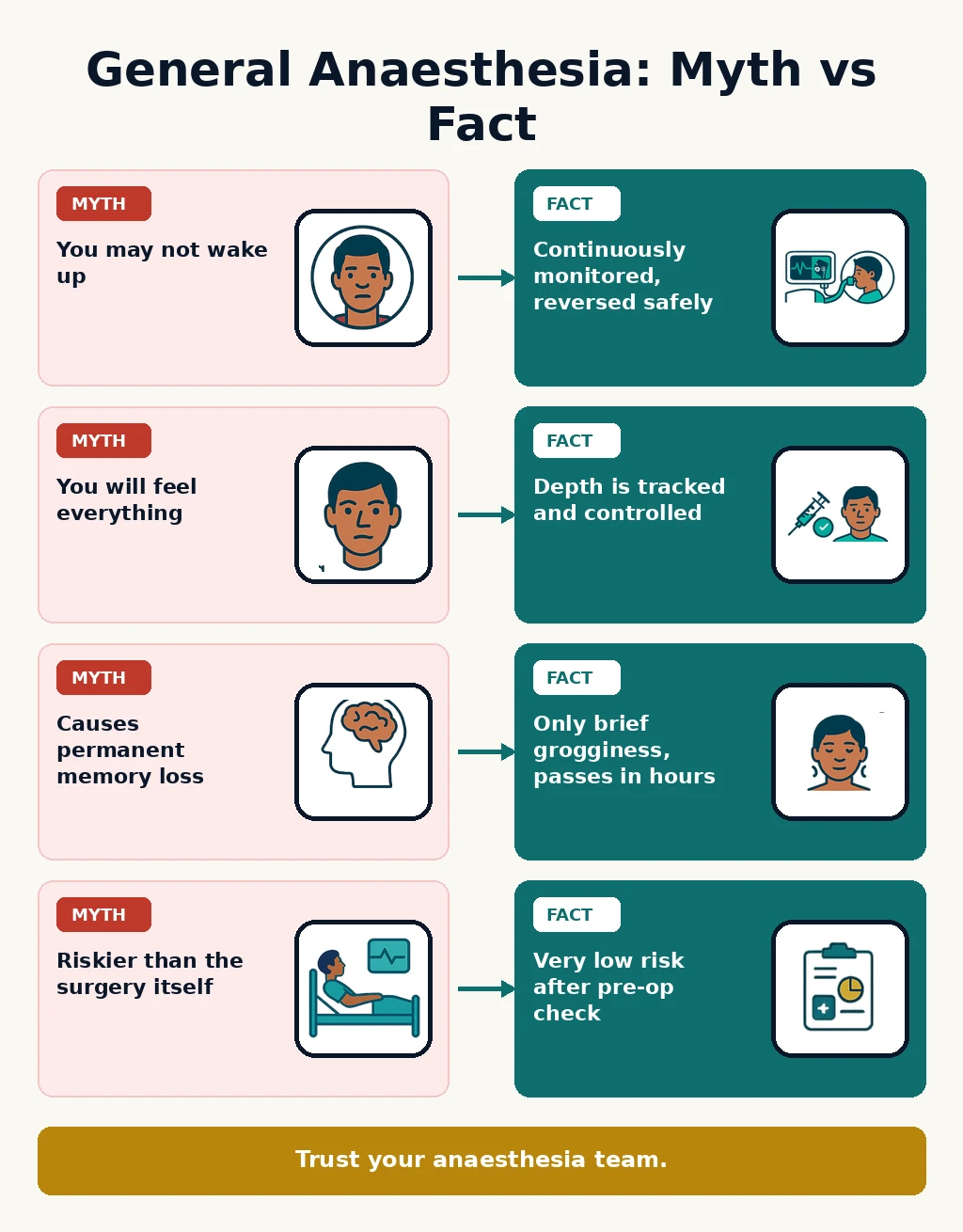
General anaesthesia myths versus facts infographic
Still Anxious About Anaesthesia?
Our anaesthesia team at Sri Ganga Hospital will walk through your specific concerns at your pre-anaesthesia checkup, before you ever reach the operating theatre.
📅 Book a Consultation 💬 WhatsApp Us