A soft swelling in a baby boy's groin or scrotum is one of the most common reasons parents bring their child to a pediatric surgeon — and one of the most treatable.
Both hydrocele and inguinal hernia happen for the same underlying reason: a small passage between the abdomen and the scrotum, present before birth, that has not closed properly. What comes through that passage — and whether it needs surgery — is what tells the two apart.
What Is a Hydrocele?
A hydrocele is a painless collection of fluid around the testis, causing the scrotum to look swollen on one or both sides. It is usually more noticeable at the end of the day or after crying, and smaller in the morning. Many hydroceles present at birth resolve on their own as the passage closes naturally over the first 12–18 months of life.
What Is an Inguinal Hernia?
An inguinal hernia happens when a loop of intestine or abdominal tissue slips through the same passage into the groin or scrotum. Unlike a hydrocele, a hernia does not resolve on its own — the opening needs to be surgically closed to prevent the intestine from becoming trapped.
How to Tell Them Apart at Home
- Size changes with crying or straining — both can bulge more when a baby cries, but a hernia bulge is often firmer
- You can usually "get above" a hydrocele on examination, but not a hernia — this is something your surgeon checks for
- Pain — a simple hydrocele is not painful; a hernia that is starting to trap tissue causes clear distress
The reliable way to tell them apart is a clinical examination by a pediatric surgeon, not guesswork at home.
When Hydrocele Needs Treatment
If a hydrocele is still present beyond about 12–18 months of age, or if it changes in character (becomes tense, painful, or appears suddenly in an older child), it is usually corrected with a short day-care procedure.
Why a Hernia Doesn't Wait
Because a hernia can trap a loop of intestine at any time — including in very young infants — it is generally repaired soon after diagnosis, even if it isn't currently causing symptoms. This is different from many adult hernias, which can sometimes be watched.
Emergency warning sign: a groin or scrotal swelling that suddenly becomes firm, red, and very painful, and will not go back in with gentle pressure, may mean the intestine is trapped (incarcerated). This needs emergency evaluation immediately, not a routine appointment.
What Hernia Repair Involves
Inguinal hernia repair in children is one of the most frequently performed and safest pediatric surgical procedures, typically done as day-care surgery with the child going home the same day. Many repairs today can be done laparoscopically through tiny incisions, which also lets the surgeon check the opposite side for a hidden hernia in the same sitting.
Recovery After Surgery
Most children are back to normal activity within a few days, with some restriction on strenuous activity for a couple of weeks. Discomfort is usually mild and well controlled with simple pain relief.
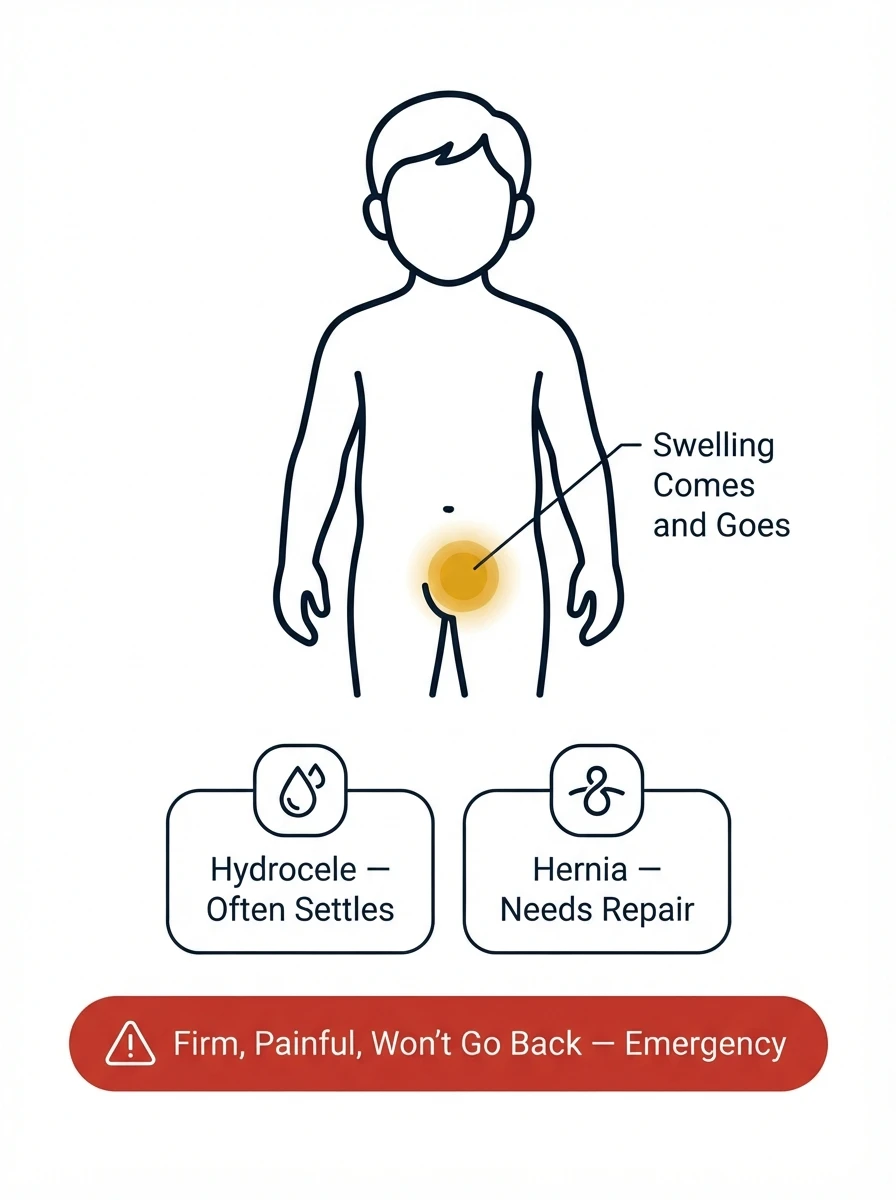
How to tell a hydrocele apart from an inguinal hernia, and when each needs surgery.
Noticed a Groin or Scrotal Swelling?
Dr. Venkatesh Kolla can examine your child and tell you within minutes whether it's a hydrocele or a hernia, and what happens next.
📅 Book a Consultation 💬 WhatsApp Us