Bedwetting is one of the most common — and most quietly embarrassing — concerns parents bring up in a pediatric consultation. Most of the time, it is simply a matter of a bladder and brain still learning to communicate overnight, and it resolves with time.
What's Normal
Nighttime bladder control develops later than daytime control, and a significant number of children are still not consistently dry at night by age 5 or 6 — this alone is not a medical problem. Bedwetting that has been present continuously since infancy, without a long dry stretch, is called primary nocturnal enuresis and is usually simply a matter of the bladder and the brain's signalling still maturing.
Primary vs Secondary Enuresis
- Primary: the child has never had an extended period of nighttime dryness — most common, usually developmental
- Secondary: the child was reliably dry at night for six months or more, and bedwetting has restarted — this is more often worth an assessment, as it can be triggered by a UTI, constipation, stress, or occasionally other medical causes
When to See a Doctor
It's reasonable to have a pediatric urologist assess your child when:
- Bedwetting continues regularly beyond age 5–6
- It restarts after a genuine dry period (secondary enuresis)
- It is accompanied by daytime wetting, pain on urination, or excessive thirst
- It is causing significant distress or affecting the child's confidence (sleepovers, school trips)
How It's Evaluated
Assessment usually starts with a simple history and examination, a urine test to rule out infection, and questions about fluid habits, constipation, and family history (bedwetting often runs in families). Further tests are needed only occasionally, when something in the history points to it.
Treatment Approaches
- Simple measures first: adjusting evening fluid intake, ensuring regular daytime toilet habits, treating constipation if present, and positive reinforcement rather than punishment
- Bedwetting alarms: often the most effective longer-term option for children old enough to use them, training the brain to wake at the sensation of a full bladder
- Medication: used selectively in specific situations, such as before a sleepover or camp, or when other measures haven't worked
Bedwetting is never the child's fault, and it is not something they can simply "try harder" to stop. A calm, practical approach — and a doctor's opinion if it's persisting — usually gets things moving faster than frustration or punishment.
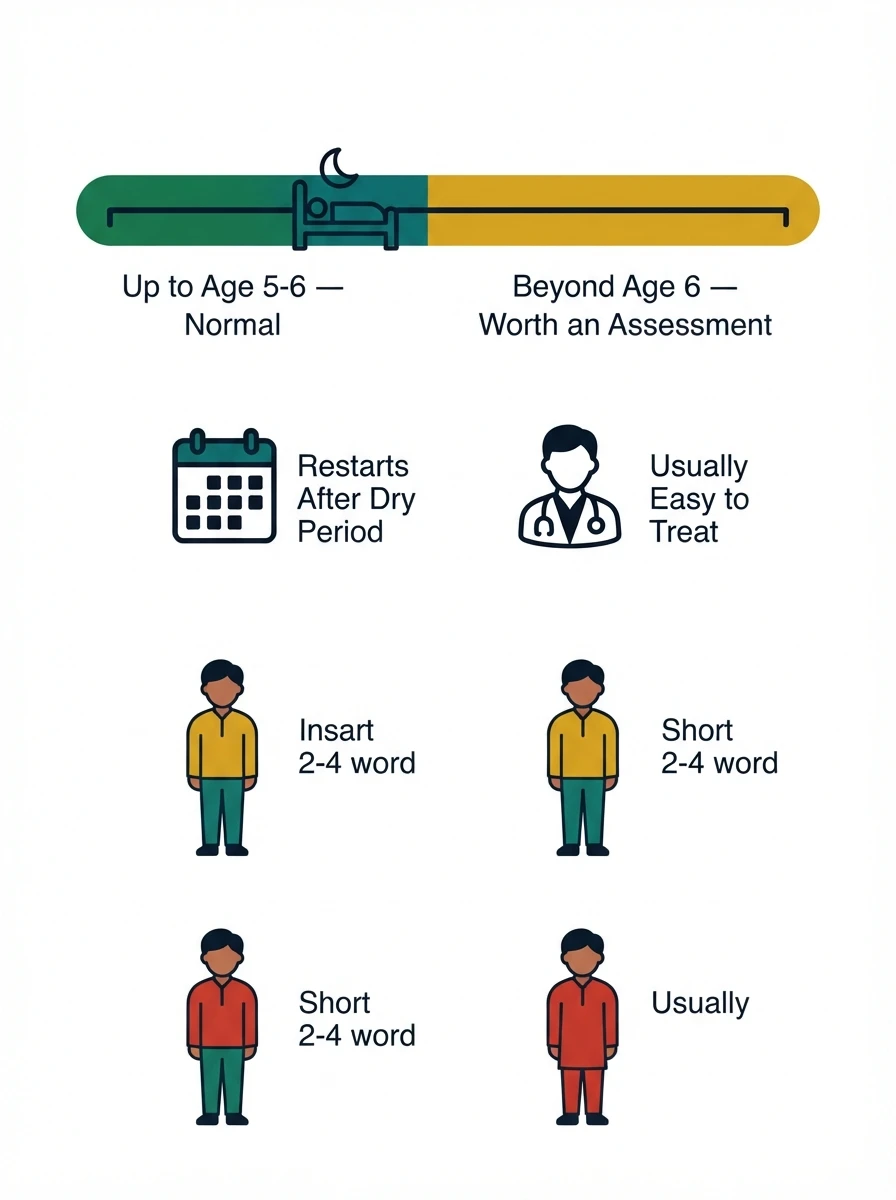
What's normal, and when bedwetting is worth a pediatric urology assessment.
School-Age Child Still Wetting the Bed?
Dr. Venkatesh Kolla can assess for an underlying cause with a straightforward, judgement-free evaluation.
📅 Book a Consultation 💬 WhatsApp Us